Ceiling Systems as Infrastructure: Designing Flexible, Energy-Efficient Data Centres

Australia’s data centre sector is expanding rapidly in response to growing demand for cloud services, artificial intelligence and high-density computing. As facilities increase in scale and complexity, systems once treated as ancillary are now recognised as integral to operational performance. Ceiling systems, in particular, influence airflow management, cooling efficiency and the coordination of service infrastructure.

Ceiling Systems as Infrastructure: Designing Flexible, Energy-Efficient Data Centres explores the principles of data centre design and examines ceiling systems through an architectural lens. This paper considers how specification choices can contribute to efficient cooling, coordinated services and flexible layouts over the life of the facility. It also provides architects with practical guidance on specifying ceiling systems that are futureproof and ready for high-density data centre environments.

Partnering with Network Architectural enables architects to approach ceiling design as an integrated architectural system. From standardised systems to custom configurations, Network Architectural offers a level of design flexibility that supports the complex spatial, thermal, airflow and service coordination requirements of data centre infrastructure.

Download the whitepaper here.

Recladding with Confidence: How the University of Sydney Delivered a Future Proof Façade

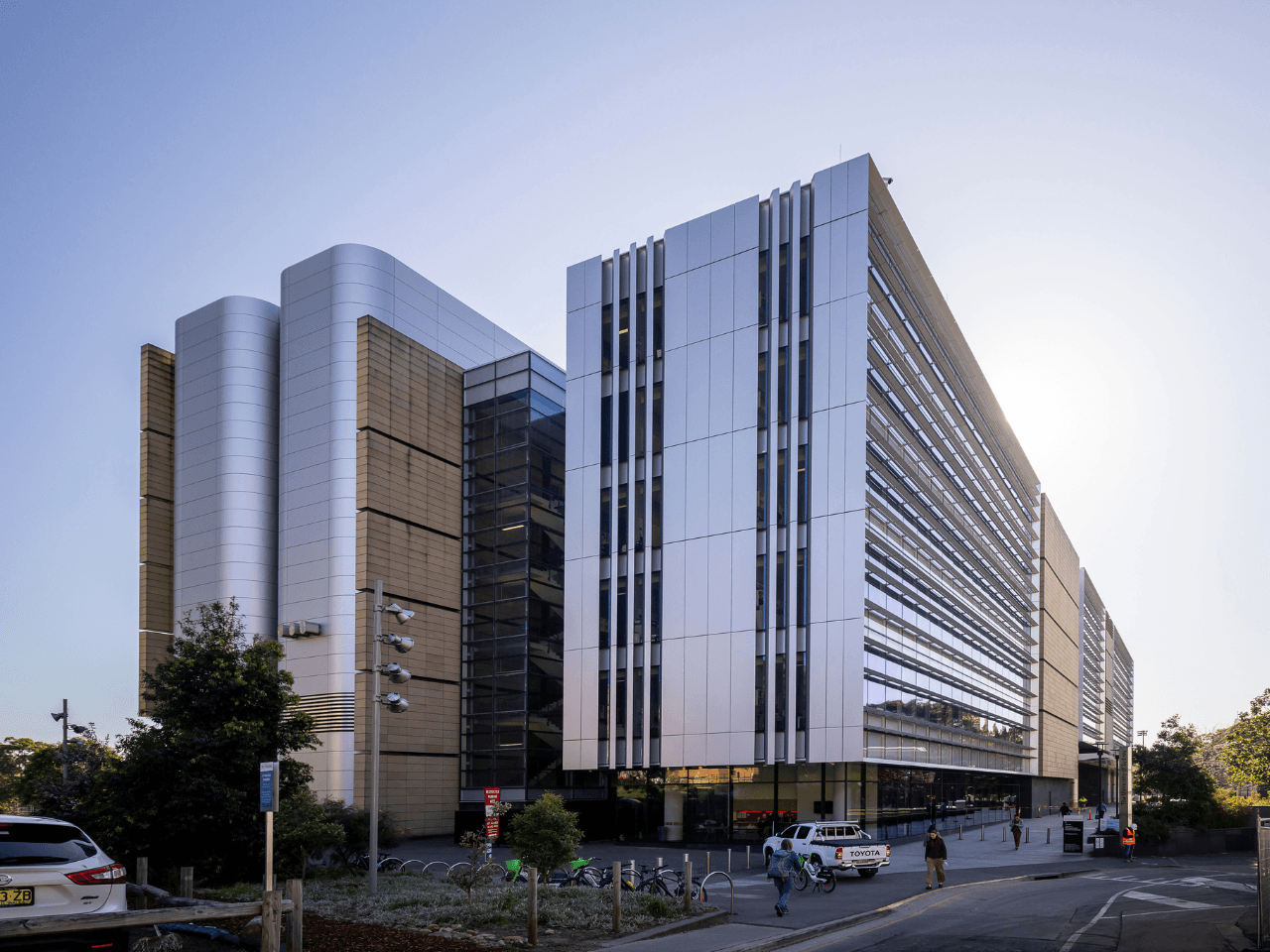
Charles Perkins Centre at the University of Sydney following recladding, featuring aluminium façade panels along Parramatta Road.

The Charles Perkins Centre is one of the most recognisable buildings on the University of Sydney campus, located on the high-traffic corridor of Parramatta Road. As a multidisciplinary hub dedicated to tackling chronic disease through collaborative research, education and innovation, the Centre represents cutting-edge thinking in both purpose and design. But when it came time for recladding the building to address non-compliant materials, it was clear that only a premium, future-proof solution would do.

A review of its façade revealed that the building’s original cladding, installed in 2015, was no longer compliant with current fire safety standards. The result is a new façade that not only meets the highest standards of compliance and safety but also enhances the Centre’s architectural integrity and long-term value.

The University was uncompromising in its expectations for the project. According to Catherine Jacob, Façade Technical Director at The University of Sydney, who managed the reclad from the University’s side, the priority was finding a cladding solution that delivered peace of mind with long-term performance:

“When you’re dealing with a flagship research facility, the last thing you want is to worry about the building envelope again in 5 or 10 years. We needed a product with zero risk of colour fade, oil canning or ongoing maintenance. ALPOLIC™ NC/A1 gave us that certainty.”

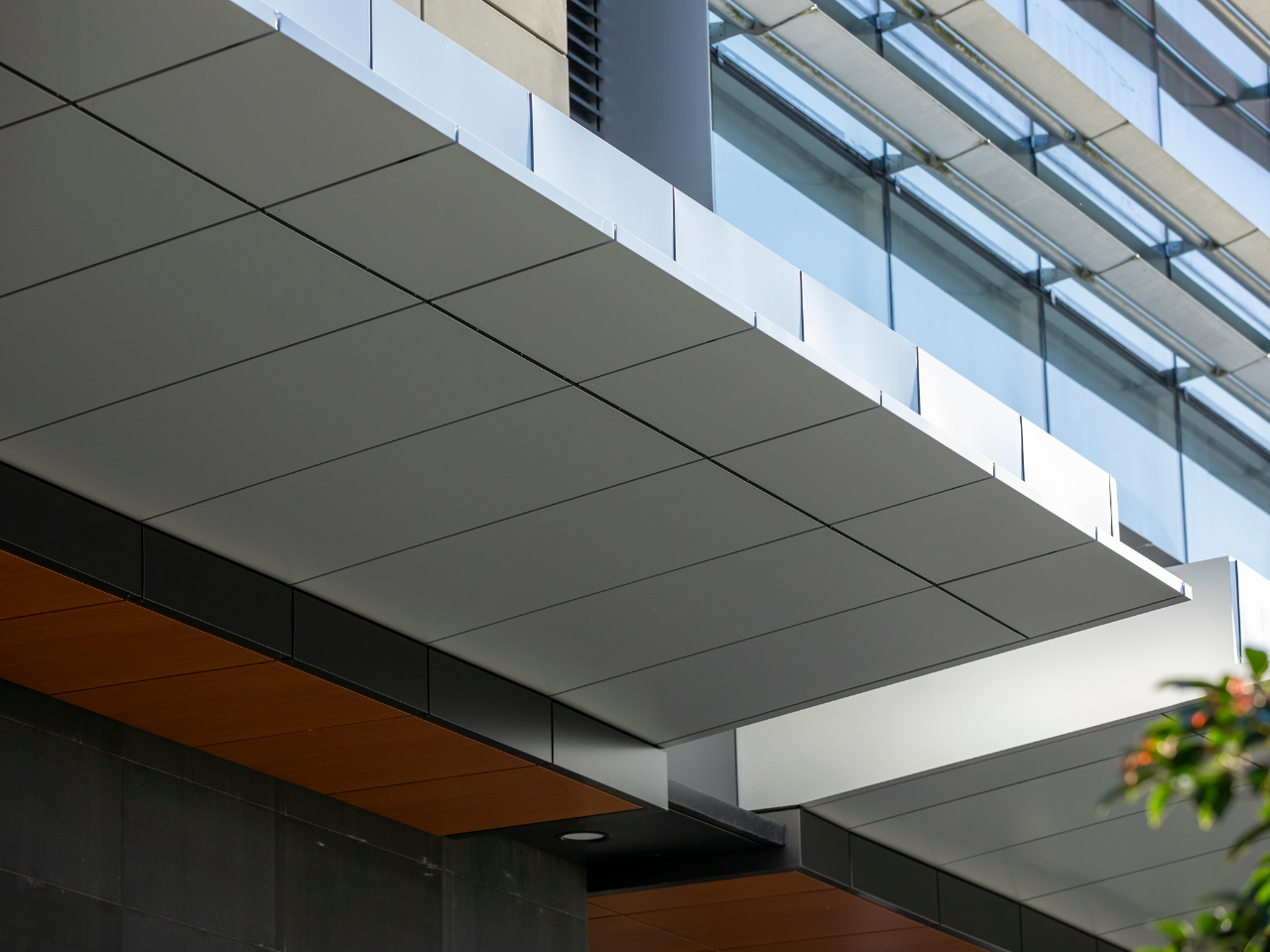
Main entrance canopy of the Charles Perkins Centre showing ALPOLIC™ aluminium soffit panels and integrated façade detailing.

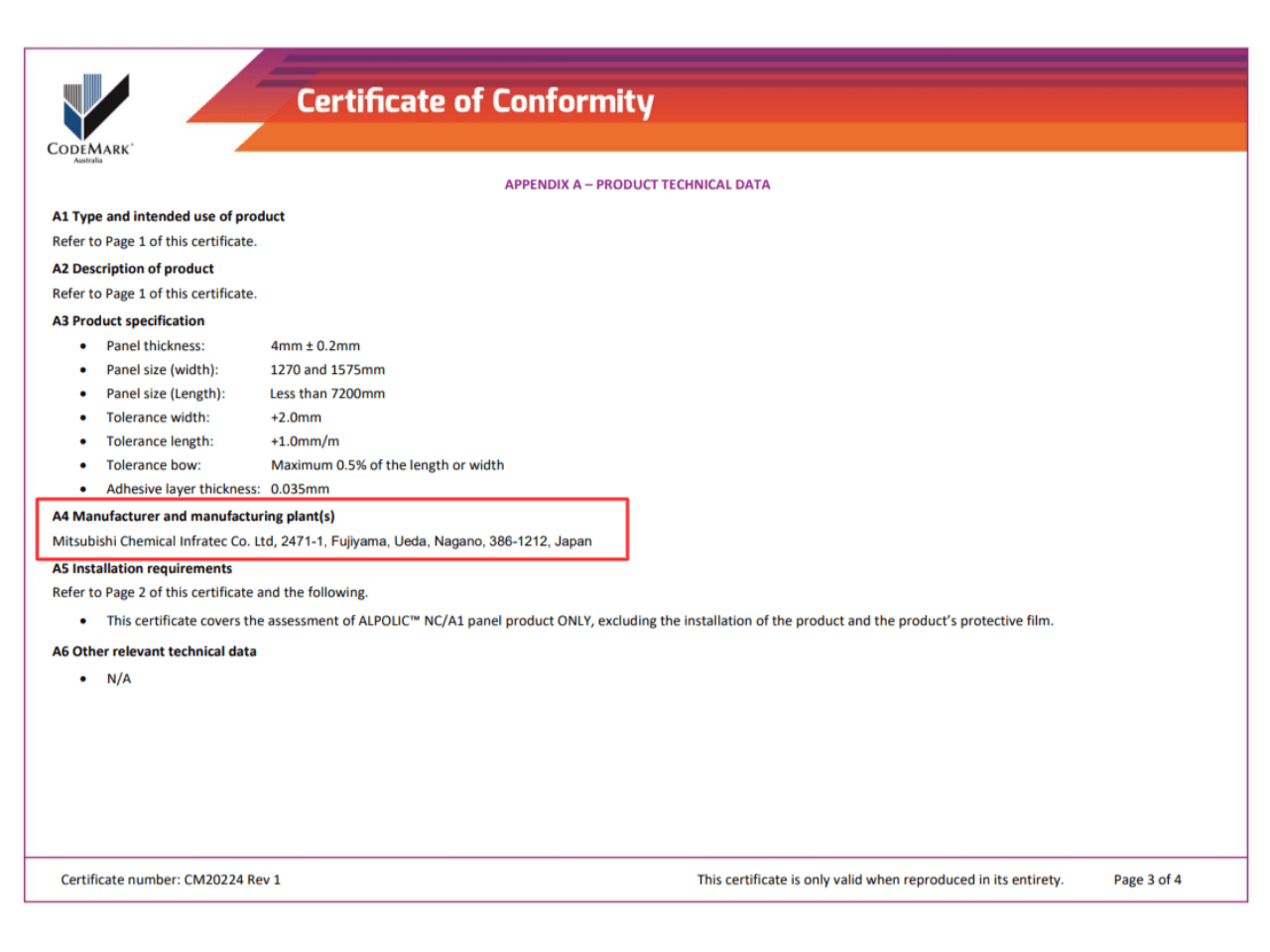
After an extensive review process, ALPOLIC™ NC/A1 by Mitsubishi Chemical Infratec (MCI) was selected. Manufactured in Japan, and exclusively distributed in Australia and New Zealand by Network Architectural, ALPOLIC™ NC/A1 is a DtS non-combustible mineral core aluminium cladding – renowned for its exceptional flatness, colour consistency and long-term durability, while meeting all relevant compliance requirements.

The decision to go with ALPOLIC™ NC/A1 was driven not just by performance, but by protection. As Llewellyn Regler, National Technical Manager at Network Architectural explains:

“The Charles Perkins Centre project really showcased why ALPOLIC™ NC/A1 is the best choice for high-profile reclads. It’s the only product on the market with a 20-year full replacement manufacturer’s warranty. That means material, labour and rectification are all covered. And importantly, there’s no catch—no maintenance required to keep that warranty valid.”

This maintenance-free advantage delivers major lifecycle cost savings and mitigates ongoing risk for facilities management.

Close-up of ALPOLIC™ aluminium soffit panels in timber finish at the Charles Perkins Centre entrance.

Design-Led Durability

Spanning 12,765m2, the new façade features ALPOLIC™ NC/A1 panels in six colours: Silver Metallic, Black, Rustik, White, Charcoal, and Manganese Metallic. The colour palette was carefully curated to complement the Centre’s existing materiality and the surrounding architectural context.

Catherine worked closely with the Network Architectural team to ensure the finishes achieved her vision:

“They gave us ten different colour samples and were extremely helpful in matching tones to our internal wood panelling. That level of detail made a huge difference. I was particularly impressed by the consistency of the metallics.”

One of the key visual performance markers was the product’s flatness. ALPOLIC™ NC/A1 is renowned for its superior rigidity and resistance to oil canning—the unsightly warping or rippling often seen with solid aluminium panels.

“On a building this size, oil canning would have been disastrous,” said Llewellyn Regler. “But ALPOLIC™ NC/A1 delivers a perfect finish, even at large panel sizes.”

Curved façade detail at the Charles Perkins Centre clad in ALPOLIC™ NC/A1 non-combustible mineral core aluminium panels.

Compliance Through Collaboration

The Charles Perkins Centre recladding is one of the largest and most complex projects to be undertaken by the University of Sydney. That meant additional layers of approval, testing and verification, requiring absolute transparency and technical rigour from everyone involved.

Working in close partnership with Buildcorp and facade contractor Aesthetic Building & Facades, Network Architectural played a hands-on role from early specification through to delivery, ensuring smooth coordination and alignment with government and regulatory bodies.

“It was a long process,” said Llewellyn Regler. “But in the end, I think they appreciated our support, responsiveness, and technical knowledge. Network Architectural was here to support every part of the process.”

More than just a safety upgrade, the recladding has restored the Charles Perkins Centre to its rightful status as a forward-thinking facility. Its new façade is not only compliant but also quietly striking, contributing to the University’s broader commitment to sustainability, safety and architectural excellence.

“It was about more than replacing panels,” said Catherine, “It was about protecting the legacy of this building and what it stands for.”

Side elevation of the Charles Perkins Centre featuring large-scale recladding with ALPOLIC™ aluminium panels.
Low-angle view of the reclad Charles Perkins Centre façade highlighting ALPOLIC™ panel alignment and architectural form.Vertical aluminium façade fins at the Charles Perkins Centre formed using ALPOLIC™ panels.

Why ALPOLIC™ NC/A1?

  • Non-combustible mineral core aluminium cladding
  • LUMIFLON™ Colour Technology so there is no colour fade
  • 20-year full replacement warranty covering materials, labour and rectification
  • No ongoing maintenance required to uphold warranty
  • The sustainable cladding choice with an Environmental Product Declaration
  • Wide range of finishes and custom colour matching available
  • Supported by Project Remediate

A Network of Expertise

With over 50 years of combined experience  supporting the Australian building industry and specialising in DtS non-combustible recladding, Network Architectural brings together market-leading façade solutions, in-house technical support and hands-on project guidance. Their exclusive partnership with Mitsubishi Chemical Infratec Co., Ltd ensures that Australian projects can access the safest, most compliant cladding products on the market—backed by service that goes beyond the spec. If you’re looking for technical advice or support with implementing a recladding solution for your building, get in touch with our expert team today.

Top 5 Residential Facade Trends in 2026 – and How ALPOLIC™ Brings Them to Life

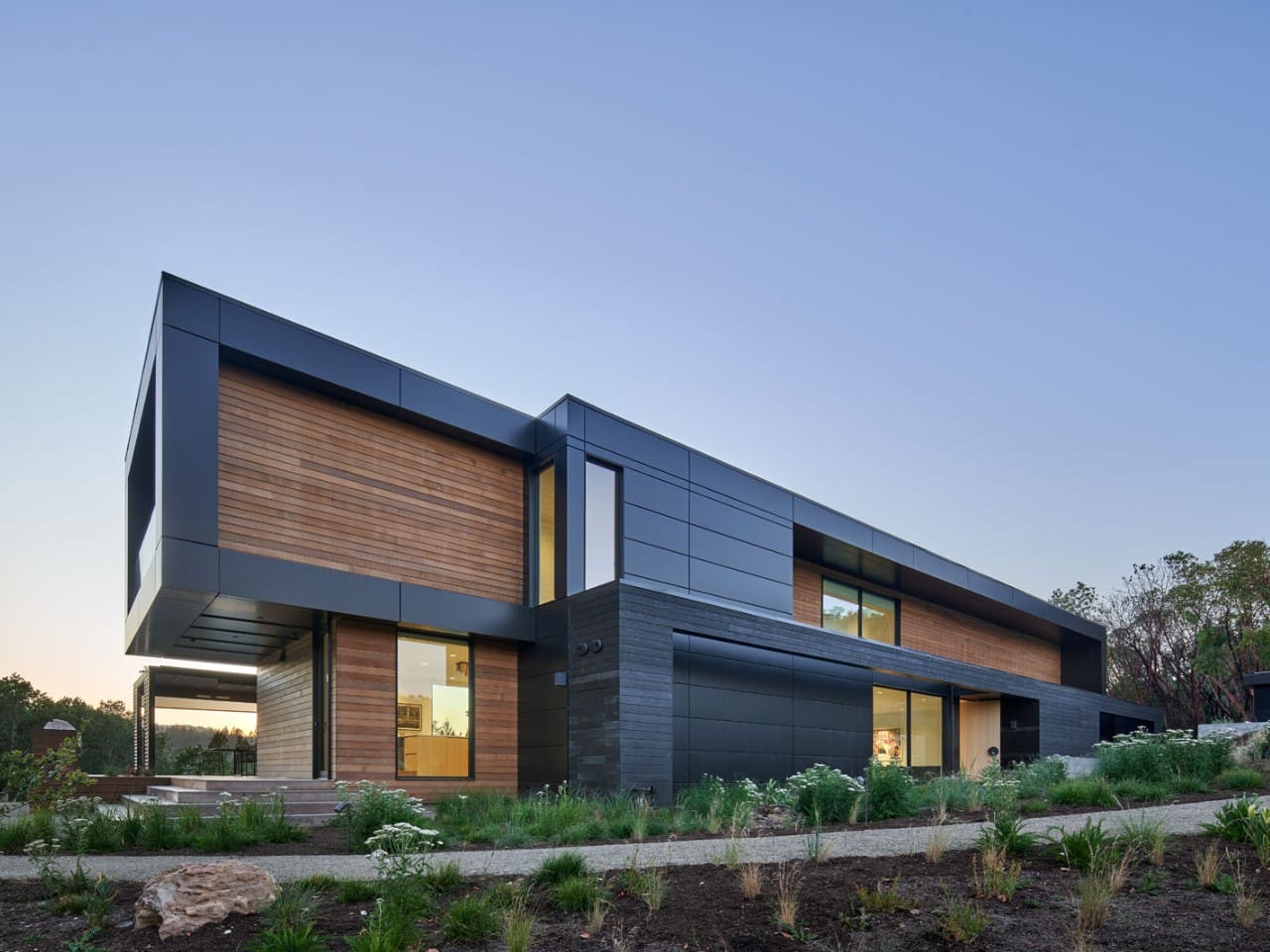
Modern Australian home with ALPOLIC™ aluminium composite cladding creating a sleek, minimalist residential façadeDOWNTEMPO | Bruce Damonte Photography | Location: California, USA | Architect: Signum Architecture | Fabricator & Installer: Fairweather Associates | Product: ALPOLIC/fr 4mm TOB Black
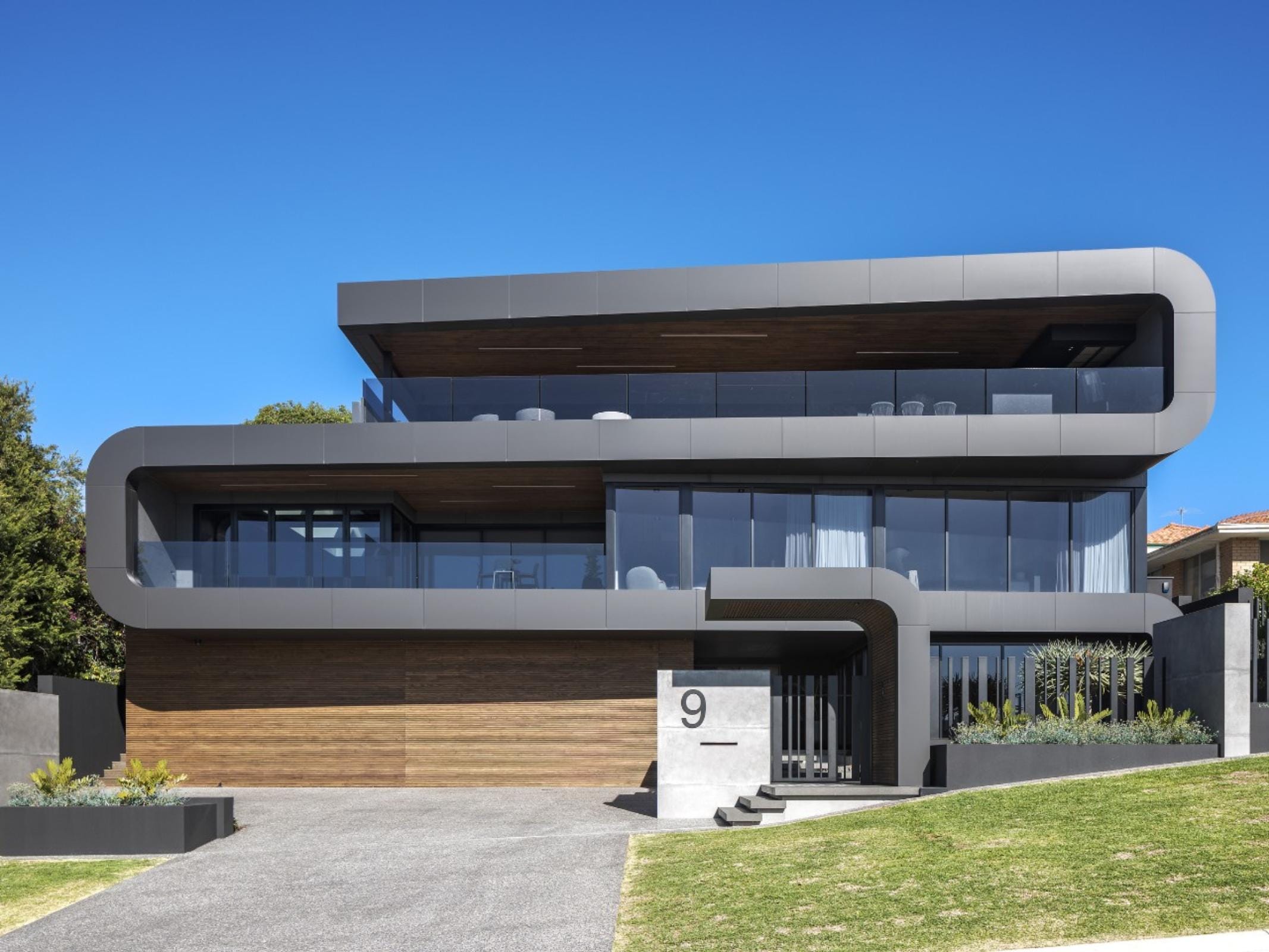
Is your facade ready to make a statement in 2026?

In modern architecture, a facade is more than an exterior finish. It is the first impression, the visual signature and a reflection of lifestyle and design philosophy.

So, as Australian residential design evolves, how will your home stand out in 2026?

From minimalist precision to bold colour accents, the latest trends demand materials that combine aesthetics, performance and safety.

This is where ALPOLIC™ architectural cladding comes in – a premium aluminium composite material that transforms facades into living design statements while performing under Australia’s toughest conditions.

Lightweight, versatile and resistant to UV, heat, and coastal salt air, ALPOLIC™ is the ideal choice for high-end residential projects that demand both beauty and endurance.

Keep reading to explore the top five residential facade trends for 2026 – and discover how ALPOLIC™ brings each one to life.

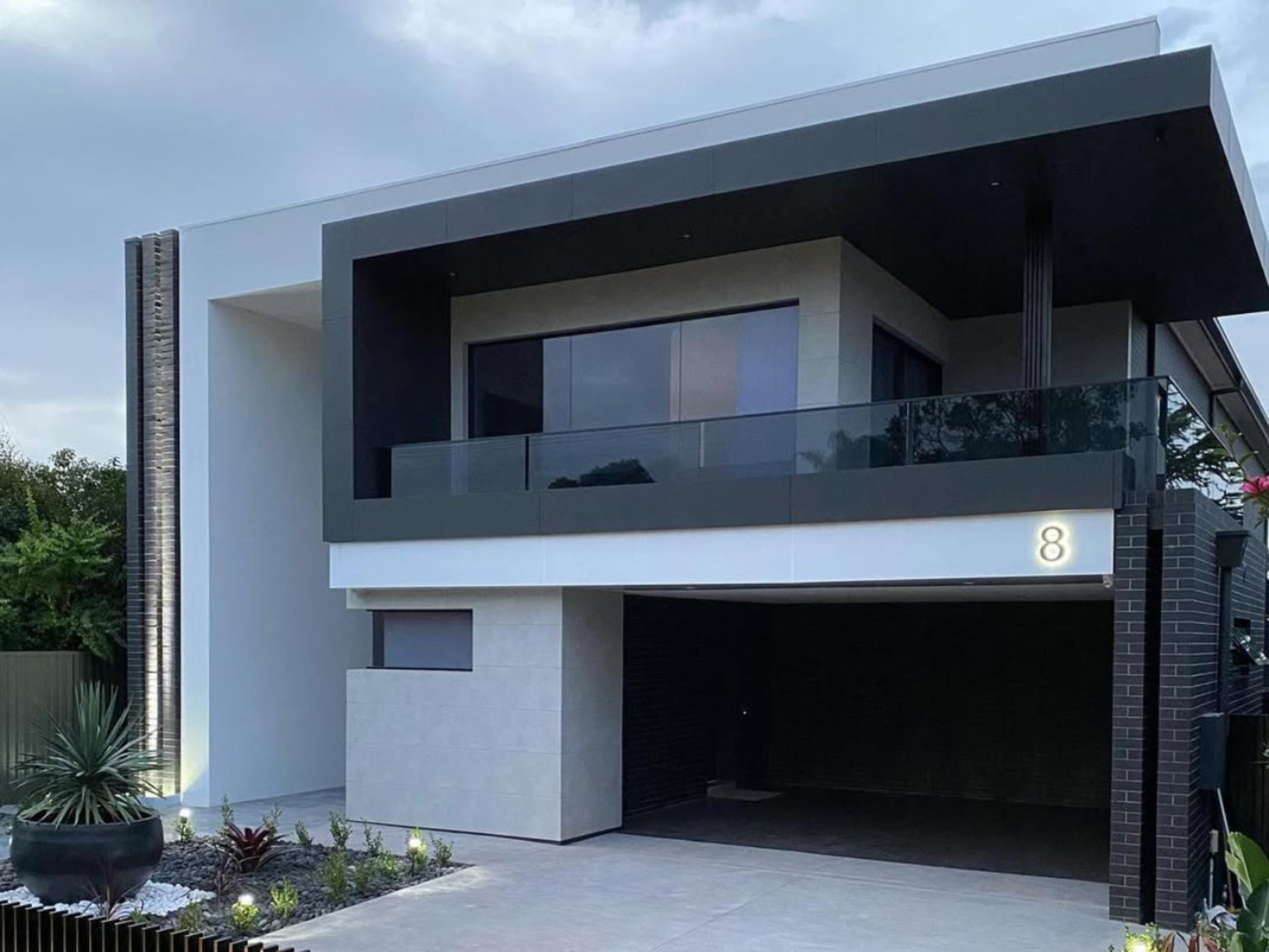
Minimalist residential façade featuring seamless ALPOLIC™ aluminium cladding with clean lines and neutral tones9 Stoke Street | Location: Mount Pleasant, WA | Designer & Builder: Premier One Constructions | Installer: Vision Clad Australia | Product: ALPOLIC™/fr Matte Slate Black
1. Minimalist mastery: how ALPOLIC™ creates sleek, seamless modern homes

Minimalism in 2026 is about precision and quiet confidence – clean geometry, subtle textures and tonal layering.

More Australian homeowners are embracing simplicity paired with functionality, creating facades that are both understated and luxurious.

Why ALPOLIC™ works for minimalist Australian homes:

  • Superior flatness creates flawless, seamless surfaces that highlight clean lines
  • Neutral tones like Charcoal or Slate Gray resist fading in harsh sunlight and remain sophisticated over time
  • Easy shaping allows for refined architectural details without visual clutter
  • Lightweight panels mean quicker installation and reduced strain on structural elements

Simplicity achieves sophistication when your
materials speak for themselves.

Minimalist designs demand a material that won’t compromise aesthetics. With ALPOLIC™, architects can achieve perfection from day one, ensuring long-term beauty and minimal maintenance.

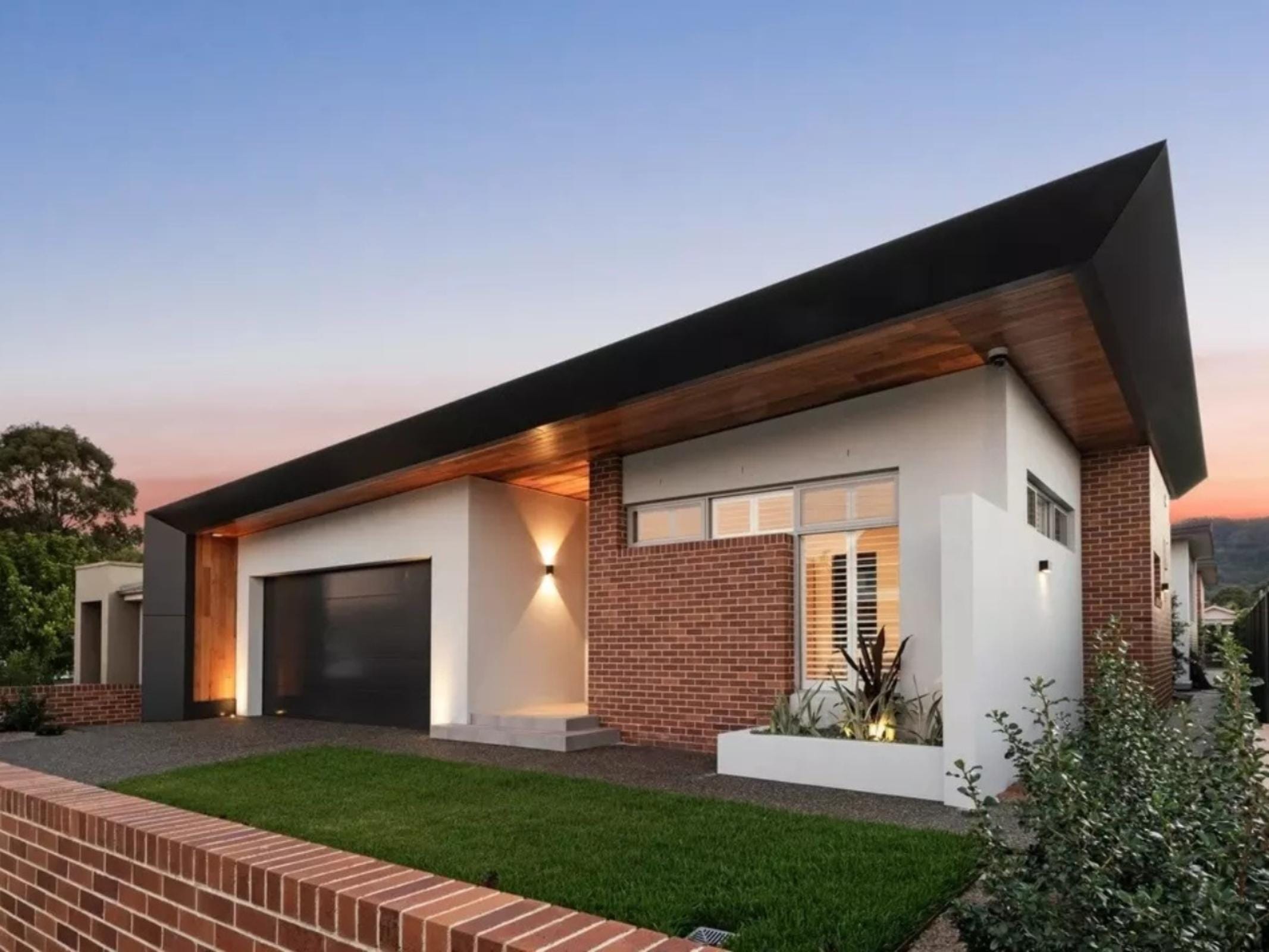
Contemporary Australian home combining ALPOLIC™ aluminium cladding with brick and timber façade elementsFairy Meadow Modern | Location: Fairy Meadow, NSW | Designer: South Coast Building Design | Product: ALPOLIC™/fr Monument
2. Mixed materials and layered facades: combining texture with ALPOLIC™

Layering materials – timber, metal and finishes – brings depth and character to modern residential designs.

In 2026, expect more Australian homes blending natural and engineered materials to create visual complexity without overwhelming the eye.

Design opportunities with ALPOLIC™ in mixed-material facades:

  • Timber Series panels add warmth and natural appeal without the upkeep of real timber
  • Metallic finishes interact dynamically with sunlight, giving facades a changing personality throughout the day
  • ALPOLIC™ panels can wrap corners and curves seamlessly, enabling creative designs that conventional cladding cannot

Texture and precision together create a facade
that is both bold and timeless.

This approach allows architects to achieve contrast, shadow play and depth – all while maintaining the high durability and fire safety ALPOLIC™ guarantees for Australian conditions.

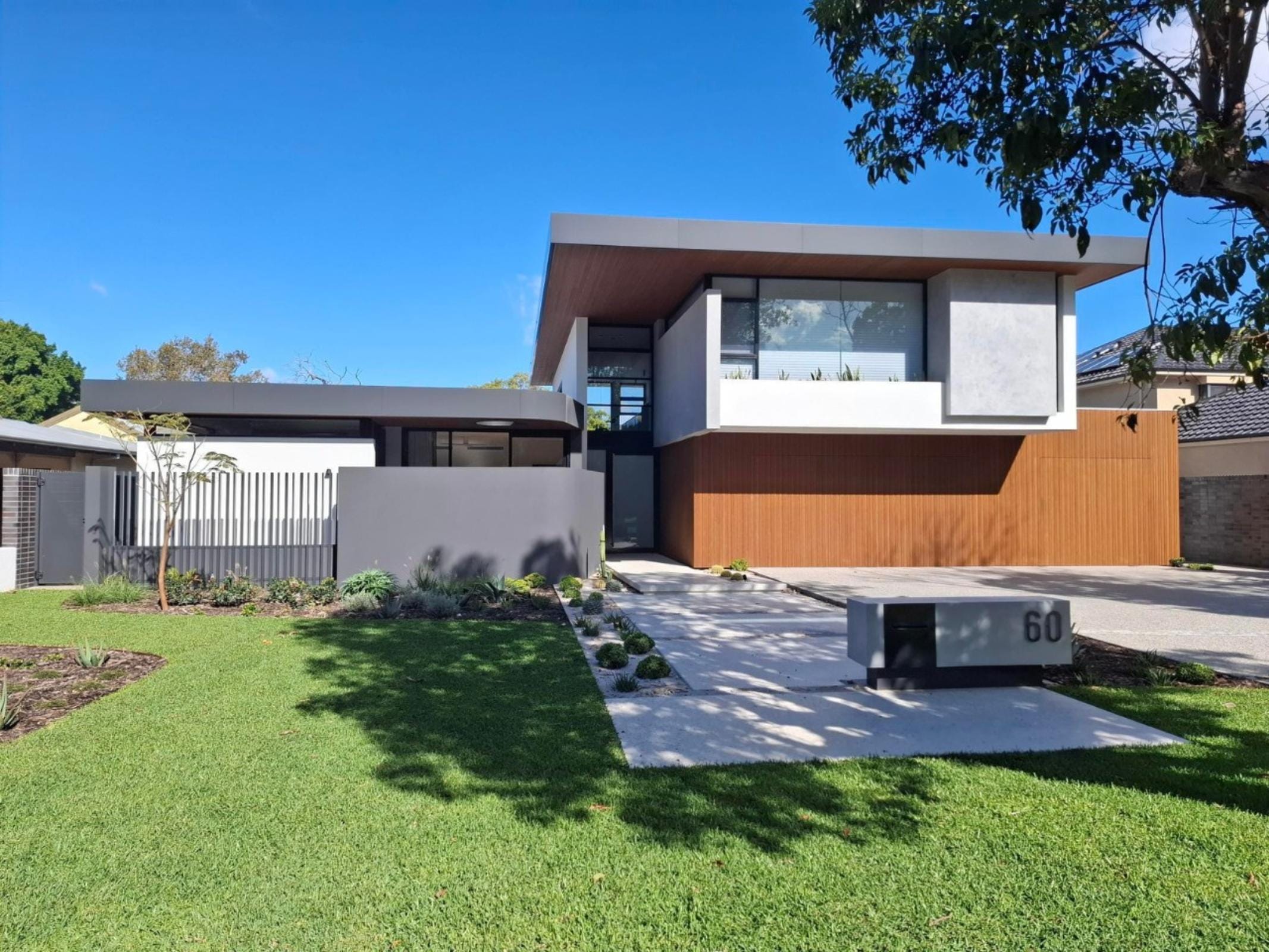
Layered residential façade using ALPOLIC™ panels and timber finishes for depth and architectural contrastGallop Road | Location: Dalkeith, WA | Architect: Roxby Architects | Builder: Time Builders | Installer: Vision Clad Australia | Product: ALPOLIC™/fr Monument
3. Embracing natural finishes: ALPOLIC™ facades that connect indoor and outdoor living

Australians have always embraced natural surroundings – and facades in 2026 mirror that harmony.

Earthy tones, organic finishes and environmental awareness are redefining how homes connect with their environment.

Why ALPOLIC™ is ideal for nature-inspired Australian facades:

  • Matte and Timber finishes evoke a raw, organic appeal
  • UV-stable coatings maintain colour vibrancy even in intense coastal sun
  • Fully recyclable materials support eco-conscious homeowners

Organic aesthetics should be effortless and maintenance-free.

ALPOLIC™ allows for indoor-outdoor harmony. Its lightweight panels are suitable for both vertical cladding, soffits, eaves, fascias and external feature walls, making it easier than ever to blend architecture with nature.

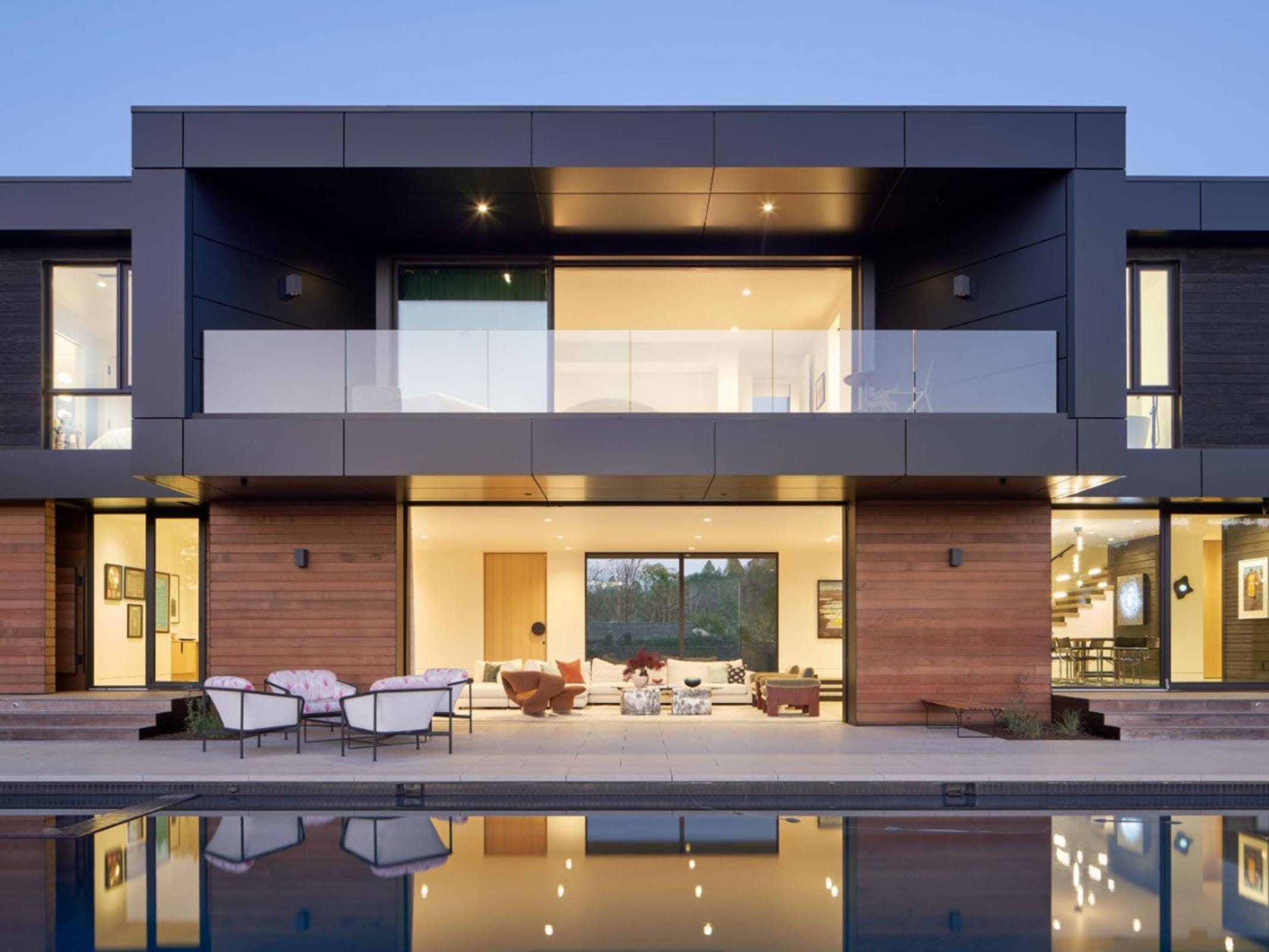
Bold residential façade featuring dark ALPOLIC™ aluminium cladding paired with timber and glassDOWNTEMPO | Bruce Damonte Photography | Location: California, USA | Architect: Signum Architecture | Fabricator & Installer: Fairweather Associates | Product: ALPOLIC/fr 4mm TOB Black
4. Bold colour accents: expressive Australian homes made simple with ALPOLIC™

Colour is back as a powerful architectural tool.

Dark, architectural tones like Monument create strong framing that highlights complementary natural materials such as timber, stone and glass. These timeless palettes bring depth, contrast and definition to modern Australian facades.

How ALPOLIC™ enhances expressive residential design:

  • Lumiflon FEVE coating prevents fading, ensuring long-lasting vibrancy in coastal or inland climates
  • Custom colour matching delivers signature Australian home designs with unique colour palettes
  • Metallic finishes reflect light dynamically throughout the day
  • High flatness ensures that bold colours appear smooth and professional, avoiding uneven finishes

A well-chosen facade colour transforms a
home into a local landmark.

ALPOLIC™’s wide palette means you can combine subtle neutrals with dramatic accents for maximum visual impact – all while staying compliant with Australian fire and building standards.

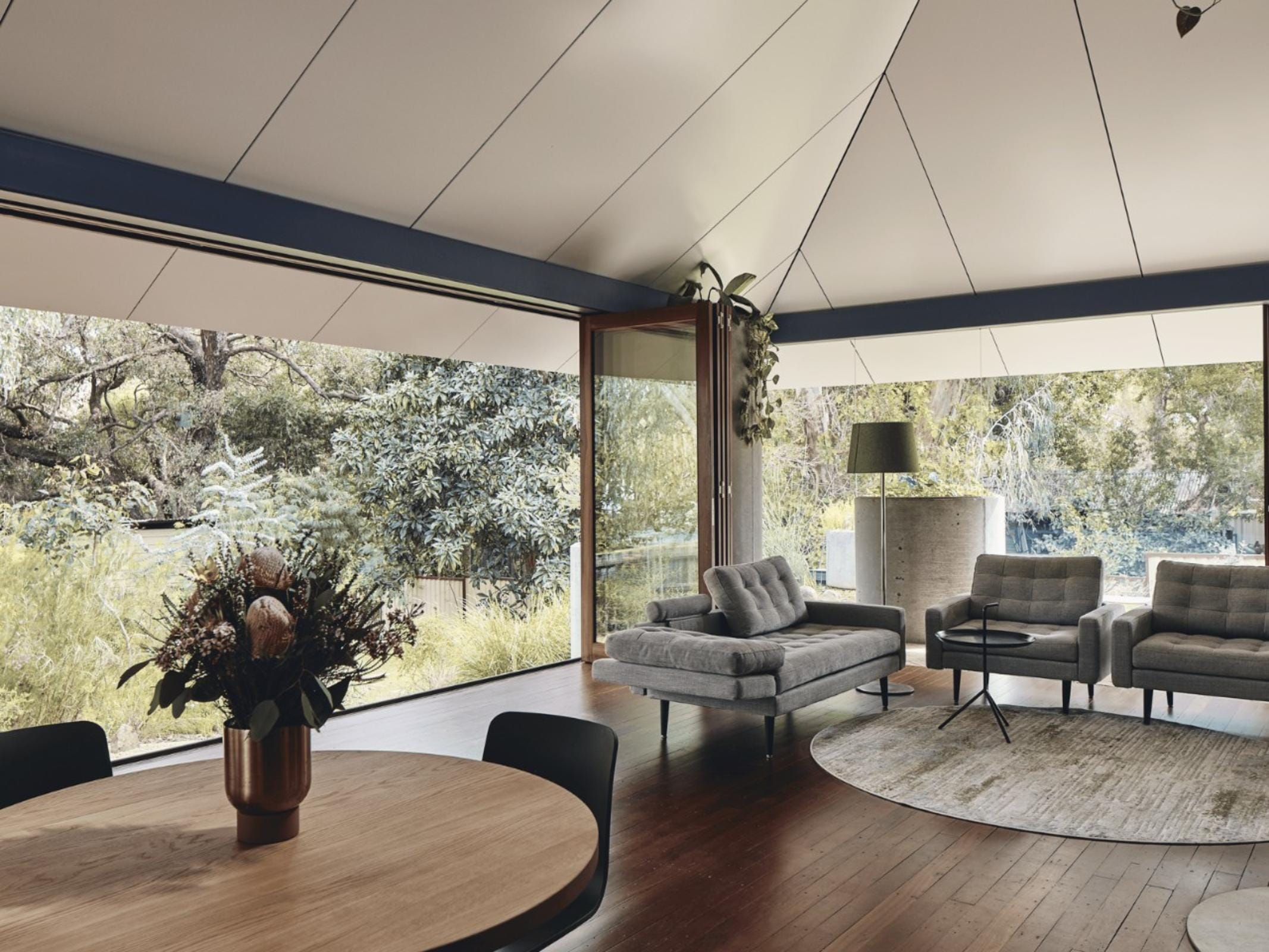
Interior living space showcasing sustainable design connected to exterior architecture using ALPOLIC™ cladding on the ceilingCelilo Springs| Location: Mount Lawley, WA | Architect: Western Architecture Studio | Contractor: Aluminium Cladding Installations | Product: ALPOLIC™/fr Medium Bronze and White
5. Sustainable architectural cladding: ALPOLIC™ keeps homes stylish and eco-friendly

Sustainability is no longer optional – it is a design imperative.

ALPOLIC™ ensures facades are both beautiful and environmentally responsible. Australian architects increasingly demand cladding that supports sustainability without sacrificing style or performance.

ALPOLIC™ sustainability highlights for Australian residential projects:

  • Fully recyclable with low-energy production methods
  • Proven durability in harsh Australian climates reduces replacement and maintenance costs
  • Supports environmentally responsible certification for green building initiatives

Sustainability should enhance design, not compromise it.

By selecting ALPOLIC™, homeowners and architects can create sophisticated facades that are future-proof, eco-conscious and visually striking.

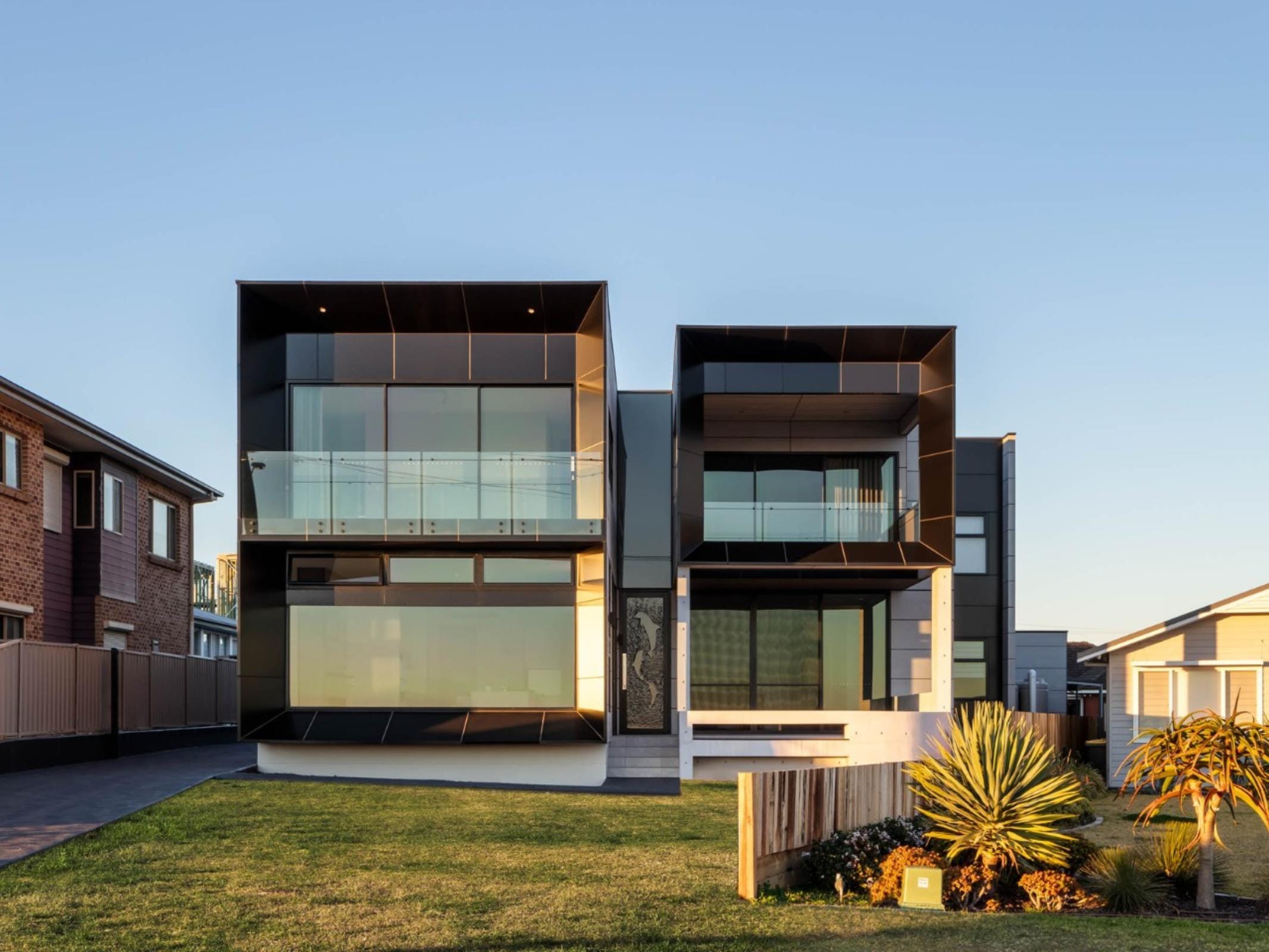
Modern dual-storey residential façade using ALPOLIC™ aluminium cladding designed for Australian conditionsThe Icon House | Location: Barrack Point, NSW | Architect: I Architecture | Builder: Smartbuild South Coast | Contractor: R&S Facades | Product: ALPOLIC™/fr Black and Monotone Slate
When design meets durability: ALPOLIC™ facades built to endure Australian conditions

 Every facade tells a story and only a few materials can combine performance, safety and aesthetics.

ALPOLIC™/fr and ALPOLIC™ NC/A1 deliver precision-built facades that are beautiful, durable and compliant with Australian standards.

ALPOLIC™/fr – Fire-Safe, Premium Residential Facades

  • Fire-retardant aluminium composite cladding
  • Ideal for high-end residential facades
  • Backed by a 20-year full replacement warranty

ALPOLIC™ NC/A1 – The World’s Safest Non-Combustible Mineral Core Aluminium Cladding

  • Non-combustible mineral core cladding
  • Euroclass A1 fire rating, the strictest international standard
  • 20-year full replacement warranty backed by Mitsubishi Chemical Infratec Co., Ltd

Architectural beauty isn’t just seen.
It’s engineered to last.

Why architects and homeowners across Australia trust ALPOLIC™

Specifying ALPOLIC™ is choosing a globally trusted, Australian-tested solution.

Architects and designers across the country rely on it for facades that combine style, safety and long-term performance.

Here’s why ALPOLIC™ continues to lead the way in Australian architectural cladding:

  • Over 50 years of innovation from Mitsubishi Chemical Infratec Co., Ltd
  • Engineered to withstand Australia’s harshest conditions
  • Backed by a 20-year full replacement manufacturer’s warranty covering materials, labour and rectification
  • Supported by an in-house architectural advisory team
  • Two premium options: ALPOLIC™/fr and ALPOLIC™ NC/A1

From minimalist statements to bold architectural facades, ALPOLIC™ delivers freedom to design without compromise.

Contemporary Australian home façade featuring ALPOLIC™ aluminium cladding specified by Network ArchitecturalBirdsall Project | Location: Sydney, NSW | Contractor: Omega Projects Aus | Product: ALPOLIC™/fr Matte Black and Off-White
Bring your 2026 residential facade vision to life with Network Architectural

At Network Architectural, we help architects, designers and homeowners transform inspiration into reality. With ALPOLIC™, every project benefits from premium aluminium composite cladding engineered for style, safety and sustainability.

Our services include:

  • Personalised project consultation
  • Technical advice and specification support
  • Connections with accredited fabricators and installers
  • End-to-end project guidance, from concept to completion

Talk to Network Architectural today.

Discover how ALPOLIC™ can elevate your next Australian residential project. Experience facade materials that perform, endure and inspire – the trusted choice of the country’s most visionary architects.

Exceptional design deserves materials that are as enduring and beautiful as your vision.

How ALPOLIC™ Became the National Standard for Toyota Dealerships

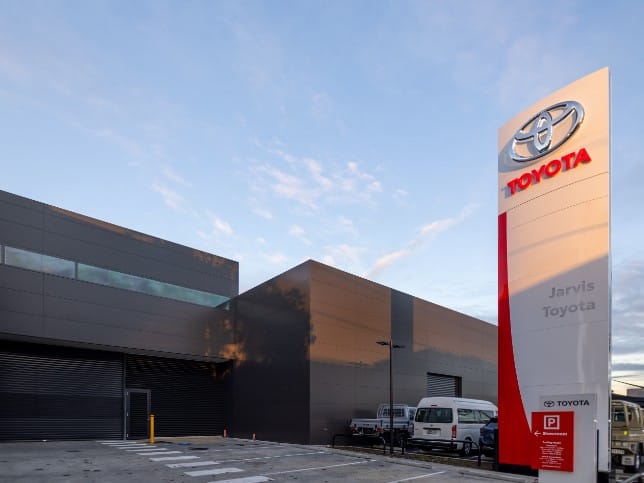
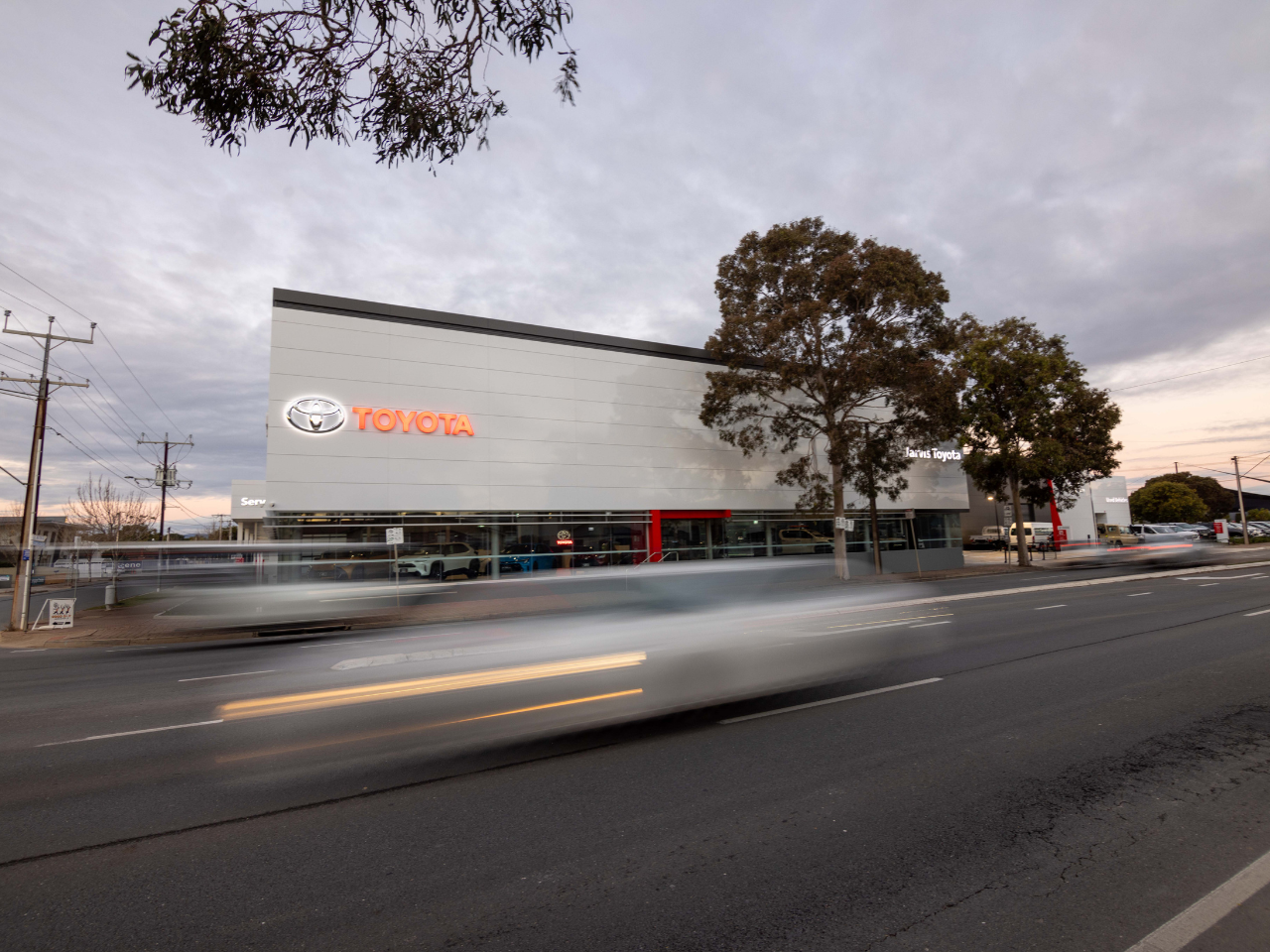
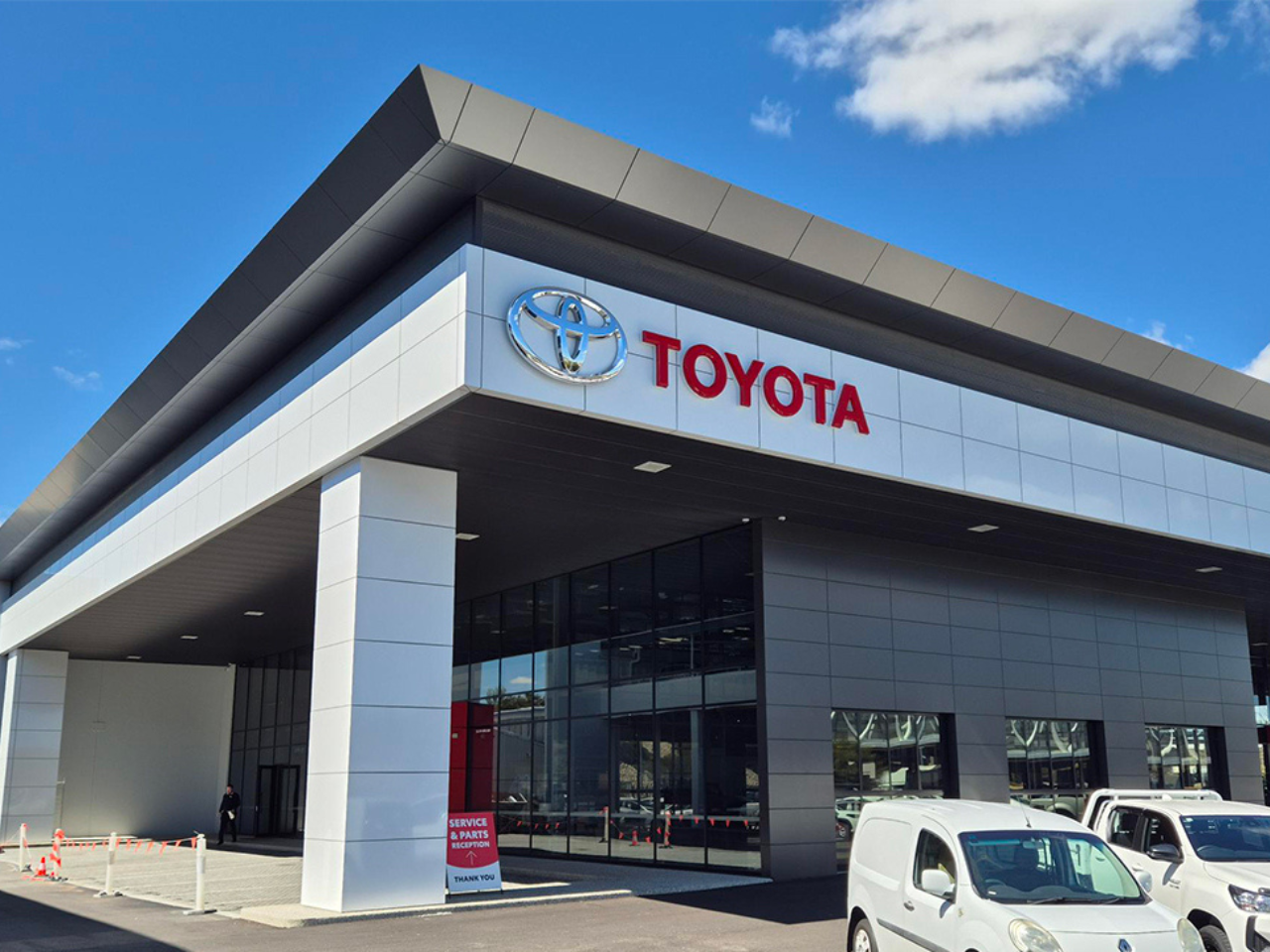
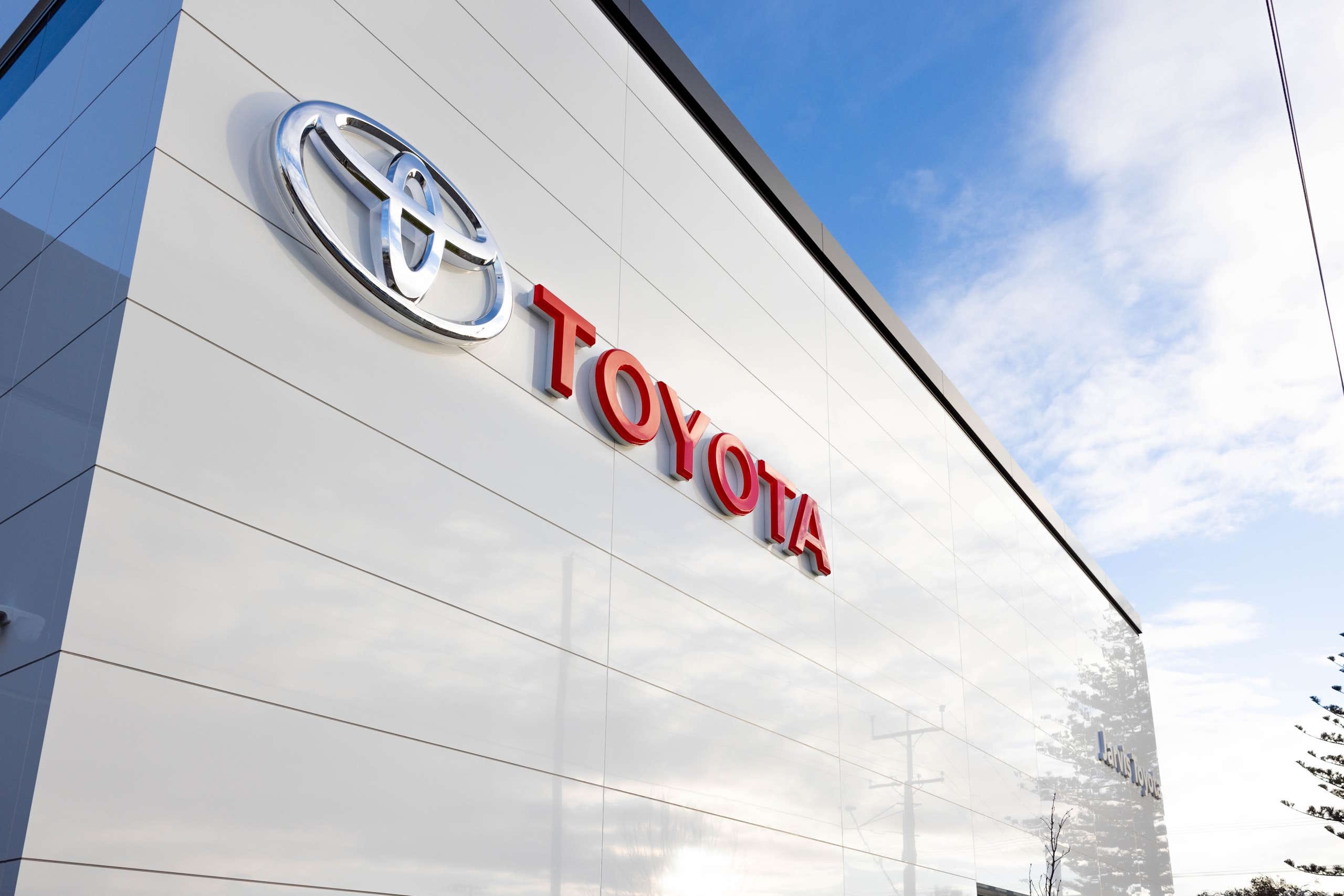
Jarvis Toyota dealership façade finished in ALPOLIC™ architectural cladding with bold Toyota signage

When it comes to branding, consistency is everything—especially for one of the world’s most recognisable automotive names. For Toyota Motor Corporation Australia (TMCA), achieving a unified visual identity across hundreds of dealerships nationwide required more than just great design. It demanded a façade and signage solution that was aesthetically seamless, fully compliant with evolving safety standards, and guaranteed to stand the test of time.

The answer? ALPOLIC™ from Network Architectural – an architectural cladding aluminium composite material (ACM) that has become the material of choice for Toyota Australia for over two decades.

Setting the Standard in Cladding and Signage

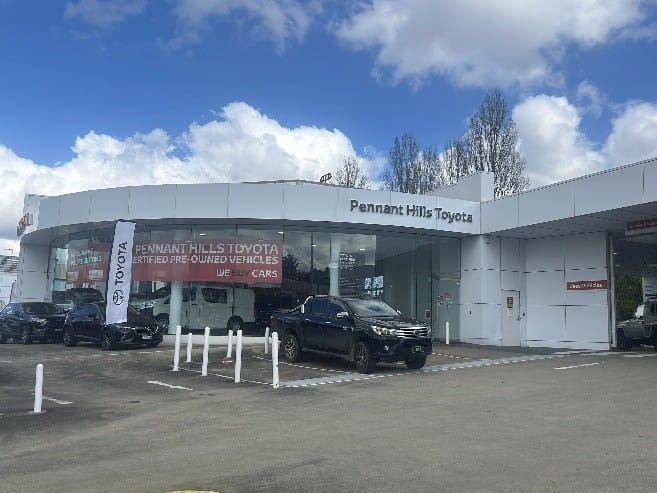
Toyota began specifying ALPOLIC™ in 2001, long before façade compliance became front-page news. The first dealership clad with the ALPOLIC™ was TMCA Pennant Hills—this dealership still showcases the original panels more than 20 years later and looks the same as they day they were installed, despite exposure to high traffic and the harsh Australian weather.

“We were the first to market with the correct fire-rated product,” says John Cantore, CID Account Manager at Network Architectural. “Toyota are very compliance-driven and risk-averse, so ALPOLIC™/fr made perfect sense—and it still does.”

What sets ALPOLIC™ apart is its unique offering: a consistent, homogenous finish across both signage and façade panels. Toyota uses ALPOLIC™/fr for signage and ALPOLIC™ NC/A1 for façades, but both carry the same colour tone, finish, and unmatched durability—something no other supplier in the market offers.

“With cheaper alternative products, we’ve seen signs fade at different rates compared to the façade. That’s not a risk Toyota is willing to take,” John explains. “Consistency in finish and warranty across both materials is a huge benefit for our customers and Toyota’s brand.”

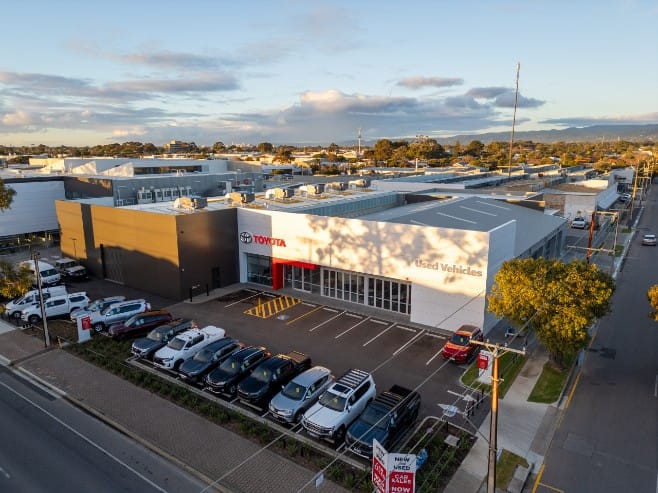
Aerial view of Jarvis Toyota dealership featuring ALPOLIC™ façade cladding and vehicle display area
Pennant Hills Toyota dealership featuring ALPOLIC™ architectural façade cladding and curved showroom frontage

Architectural Cladding Compliance

Following global events like the Grenfell Tower fire (2017) and Melbourne’s Lacrosse fire (2014), the spotlight on cladding compliance has only intensified. Insurers became more cautious, often refusing coverage if ACM panels were used—unless full compliance could be demonstrated.

This is where Network Architectural’s value goes far beyond product supply.

“We worked hand in hand with TMCA, tackling site-by-site compliance concerns,” says John. “Network Architectural engaged façade engineers to develop Performance Solutions that enabled ALPOLIC™ to be approved for installation, even during the most risk-averse period in the industry.”

This approach effectively transferred the risk from Toyota and onto certified façade engineers, who had the data and backing of ALPOLIC™’s technical division to support their decisions. “Having that kind of partnership support was a game-changer” says John.

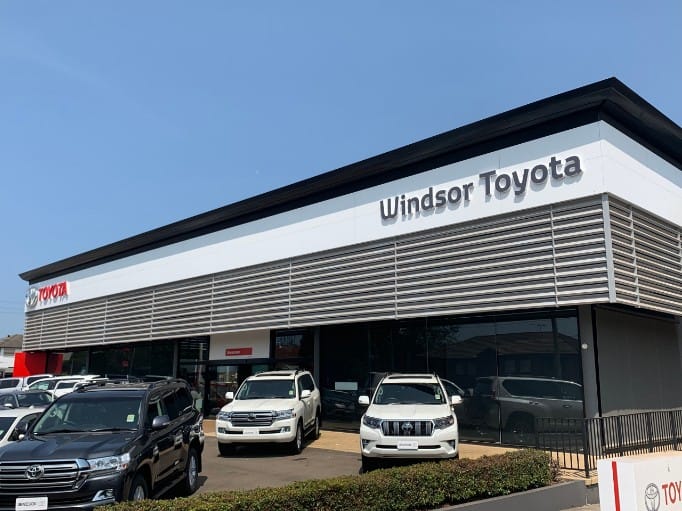
Windsor Toyota dealership with ALPOLIC™ façade cladding and contemporary louvre detailing
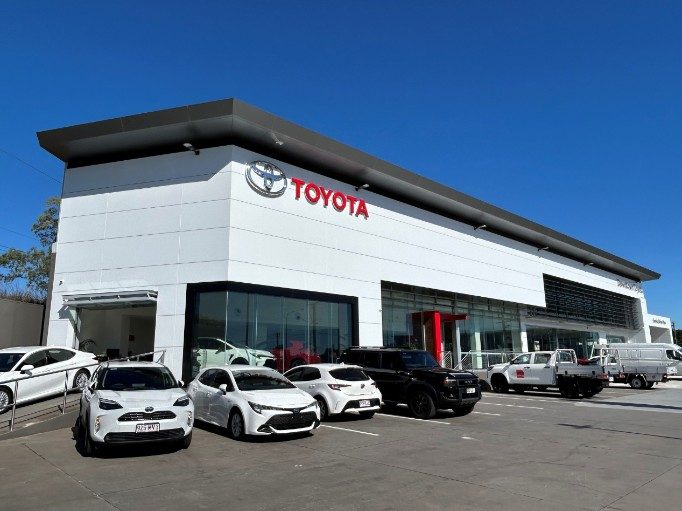
Toyota dealership exterior showcasing ALPOLIC™ architectural cladding and modern entry frontage

A Product with Proven Performance

Beyond compliance, ALPOLIC™ is engineered to last. It’s the only product in the market that uses Lumiflon FEVE technology, allowing Toyota to achieve its signature high-gloss white (G80) finish—a key feature in the brand’s identity manual. Ultimately this technology means that the colour maintains it integrity for up to 60 years.

And thanks to a full 20-year replacement warranty with no maintenance requirements, the panels don’t just look good—they perform, year after year.

“There have been zero changes to the finish in over 20 years,” John notes. “So whether you’re visiting a dealership completed in 2001 or one installed last month, the aesthetic is identical. That kind of durability is rare.”

While the product speaks for itself, Toyota’s long-term relationship with Network Architectural is built just as much on trust and service as it is on performance.

“We complete around 40 dealerships every year, and TMCA supports us every step of the way,” John says. “From technical consultations to performance documentation, our team is incredibly hands-on.”

It’s a view echoed across the TMCA network.

“ALPOLIC™ allows us to meet our national design standards without compromise. We trust Network Architectural to deliver not only a world-class product, but also the support that ensures compliance, consistency, and confidence across all our sites.” says TMCA.

Jarvis Toyota building with dark ALPOLIC™ façade cladding and prominent Toyota pylon signage
Noble Toyota dealership featuring ALPOLIC™ façade cladding with clean geometric panel design

ALPOLIC™/fr and NC have become such a critical part of Toyota’s design ecosystem that they are now embedded in the company’s national Start Manual—a governance tool for dealership construction. Builders and fabricators know exactly what’s required, and their approved signage provider, Signcraft, follows suit.

“TMCA don’t accept alternative materials for their cladding or signage because the products are already carefully pre-selected to represent their brand,” says John. “This is how Toyota sustains a premium and uniform brand presence throughout Australia.”

One of the most distinctive features enabled by ALPOLIC™ is the Dark Gray Metallic fascia known as the ‘eyebrow,’ a consistent visual element that has become a hallmark across TMCA dealerships.

“Seeing that bold architectural feature come to life in ALPOLIC™ on every dealership is something we’re really proud of,” says John. “It’s proof that compliance and creativity can absolutely go hand in hand.”

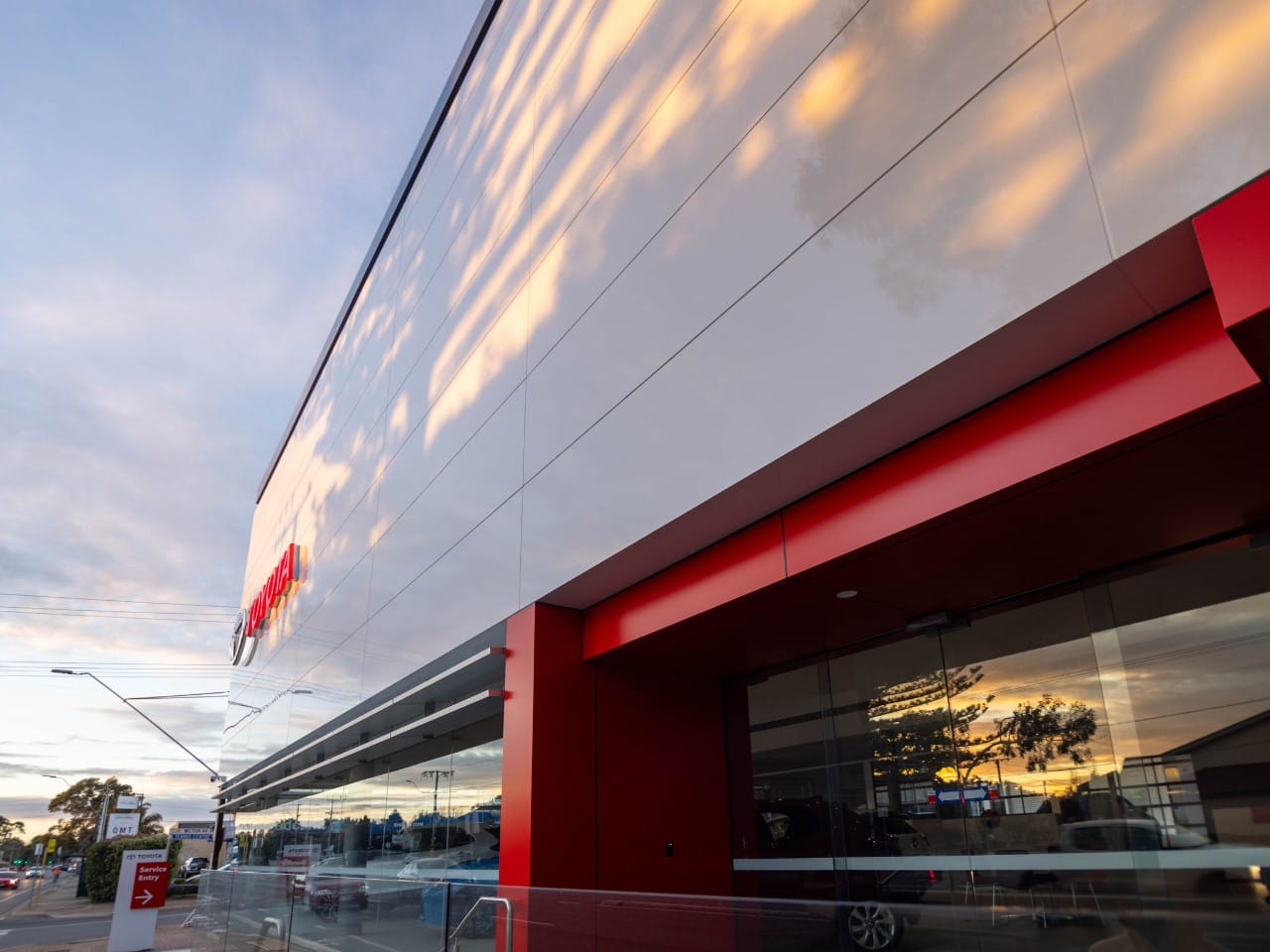
Close-up of Toyota dealership façade with glossy ALPOLIC™ architectural cladding and red entry feature

Ready to Specify ALPOLIC™?

Whether you’re an architect working on a flagship retail space or a brand looking to maintain consistency across multiple locations, ALPOLIC™ from Network Architectural delivers the ideal balance of durability, compliance, and design impact.

With unmatched technical support, hands-on architectural guidance, and a customer-first approach, our team at Network Architectural is here to help you every step of the way—from product selection, colour samples to project delivery. Visit our ALPOLIC™ product page to explore the full range of benefits and be sure to check out our projects page to see how ALPOLIC™ is being used on real-world projects across Australia.

Have a project in mind? Contact our team for tailored advice and specification support.

Sustainability eBook 2025

For the fourth year running, Network Architectural was proud to support Architecture & Design’s Sustainability Awards as partner of the Commercial Architecture – Large category. The program continues to spotlight projects that are raising the bar for sustainable design across Australia.

The 2025 shortlist was particularly strong, and the jury recognised two exceptional projects for their thoughtful approach to materials, performance and connection to place.

A big congratulations to Hassell for First Building – Bradfield City Centre and Searle x Waldron Architecture for Northern Memorial Park Depot. Both were awarded winner status this year and demonstrate how sustainability can be embedded into design without compromising ambition.

Our Sustainability eBook 2025 pairs these project highlights with our latest insights, including the industry’s shift toward zero-carbon aluminium, the increasing importance of lifecycle assessment and how to interpret EPDs with clarity and confidence.

Download the eBook to explore the ideas shaping sustainable architecture today and see how leading practices are putting them into action.

Understanding Facade Warranties: What Designers Should Ask Before Specifying Cladding

Facade systems operate in demanding environments, exposed daily to UV radiation, wind pressure and moisture. Their longevity depends on selecting materials and assemblies that maintain integrity over time. Warranties play a vital role in defining how responsibility is shared when performance issues arise. However, coverage can differ significantly between products and unclear terms may expose stakeholders to significant risk.

Understanding Facade Warranties: What Designers Should Ask Before Specifying Cladding is an essential guide that helps architects and specifiers evaluate facade warranties. It outlines the key elements to review in warranty documentation, from coverage limits and exclusions to maintenance obligations and transferability. Practical guidance and example questions help designers assess whether warranty terms align with project and client requirements.

Available from Network Architectural, ALPOLIC™ NC/A1 aluminium composite cladding distinguishes itself with its market-leading 20-year unconditional full-cover manufacturer’s warranty. Backed by Mitsubishi Chemical Infratec Co., Ltd., the warranty includes materials, labour, access and rectification costs. It requires no cleaning or maintenance to remain valid. Where other facade systems offer limited materials-only coverage or impose restrictive maintenance clauses, ALPOLIC™ provides genuine, end-to-end protection directly from the global manufacturer.

Download the whitepaper here.

A declaration is a disclosure, not a sustainability guarantee: Network Architectural debunks the EPD myth

Modern façade of Charles Perkins Centre in NSW, showcasing sustainable architectural cladding.

Charles Perkins Centre, Sydney NSW

The industry’s collective pursuit of increasingly ambitious environmental agendas is often anchored by Environmental Product Declarations (EPDs), which, over the last few years, have become an undeniable cornerstone of sustainable design. Navigating complex certification requirements can be a particularly time-consuming and detail-oriented exercise, and this demanding process has inadvertently solidified the role of EPDs as efficient seals of approval in many specifiers’ minds. We’ve grown accustomed to the idea that if a product has an EPD, then it must be sustainable.

Unfortunately, warns Llewellyn Regler, National Technical Manager at Network Architectural, this common and largely well-intentioned assumption is a critical oversimplification. “The belief that the mere presence of an EPD makes a product sustainable is a myth,” Llewellyn says. “And one that risks undermining the very goals a project might be aiming to achieve.”

The dream of simplicity

According to Llewellyn, this misconception is rooted in a desire for clarity in an increasingly complex field. “EPDs have become synonymous with sustainability in many procurement and certification processes,” he explains. “There’s a misconception that the presence of an EPD means a product meets a certain environmental standard – but in reality, an EPD is a disclosure tool, not a rating system. The growing demand for sustainable design has driven architects and specifiers to look for straightforward ways to demonstrate environmental responsibility, and, unfortunately, that’s often led to a ‘tick-box’ approach.”

Llewellyn adds that this is particularly true for large-scale commercial projects, where decisions must be made and documented with exceptional efficiency. However, by treating EPDs as an administrative formality, the industry risks overlooking the rich, nuanced data they contain, which could potentially lead to suboptimal material choices.

Façade of Jarvis Toyota dealership in South Australia featuring ALPOLIC™ non-combustible mineral core aluminium cladding.

Jarvis Toyota, SA

The indisputable value of an EPD

This is not to say that EPDs don’t hold immense value – they do. And they are an indispensable part of the sustainable specification process. “EPDs provide transparent, standardised data on a product’s environmental impacts throughout its life cycle – most notably in the A1–A3 stages, which cover raw material extraction and manufacturing,” Llewellyn notes. “This makes them valuable for comparing products within the same category and for contributing to lifecycle assessments and certification schemes like Green Star.”

Their superpower is undoubtedly their ability to help assess a product’s embodied carbon, measured as Global Warming Potential (GWP). And as ESG reporting becomes non-negotiable, this data is more vital than ever, making an EPD a crucial starting point. However, Llewellyn points out, that’s precisely what an EPD is: a beginning. To find genuine environmental guarantees, industry professionals must dig deeper. What exactly should they be looking for?

Looking for guarantees, not declarations

In short: context. “An EPD simply presents data,” Llewellyn explains. “It does not interpret that data or provide context. Two vastly different products can both have EPDs, but one may have triple the embodied carbon of another.”

Llewellyn adds that this is a critical distinction, particularly for materials like façade cladding. “For instance, our recent CPD comparing GWP from fossil fuels demonstrates significant differences between three different types of aluminium products,” he adds. “A 3mm solid aluminium panel has a GWP of 61.45 kg CO₂e/m². In comparison, a corrugated core panel sits at 34.10 kg CO₂e/m², while a mineral core panel – like ALPOLIC™ NC/A1 – comes in at just 19.74 kg CO₂e/m².”

This disparity highlights the fact that, although all three products may have EPDs, it’s clear that they’re not as sustainable as one another. Their embodied carbon footprints are worlds apart and streamlining an EPD review to a quick box-ticking exercise would completely miss this crucial performance difference.

But that’s not the only challenge – Llewellyn notes that EPDs often fail to capture other vital long-term sustainability factors. Durability, maintenance requirements, warranty conditions and lifecycle costs are all critical considerations that fall outside the conventional scope of an EPD but have profound environmental and economic consequences over a building’s life.

“A product may have a low impact at the manufacturing stage but require regular repainting, refinishing, or early replacement,” Llewellyn goes on. “And that drives up environmental impact and lifecycle costs.”

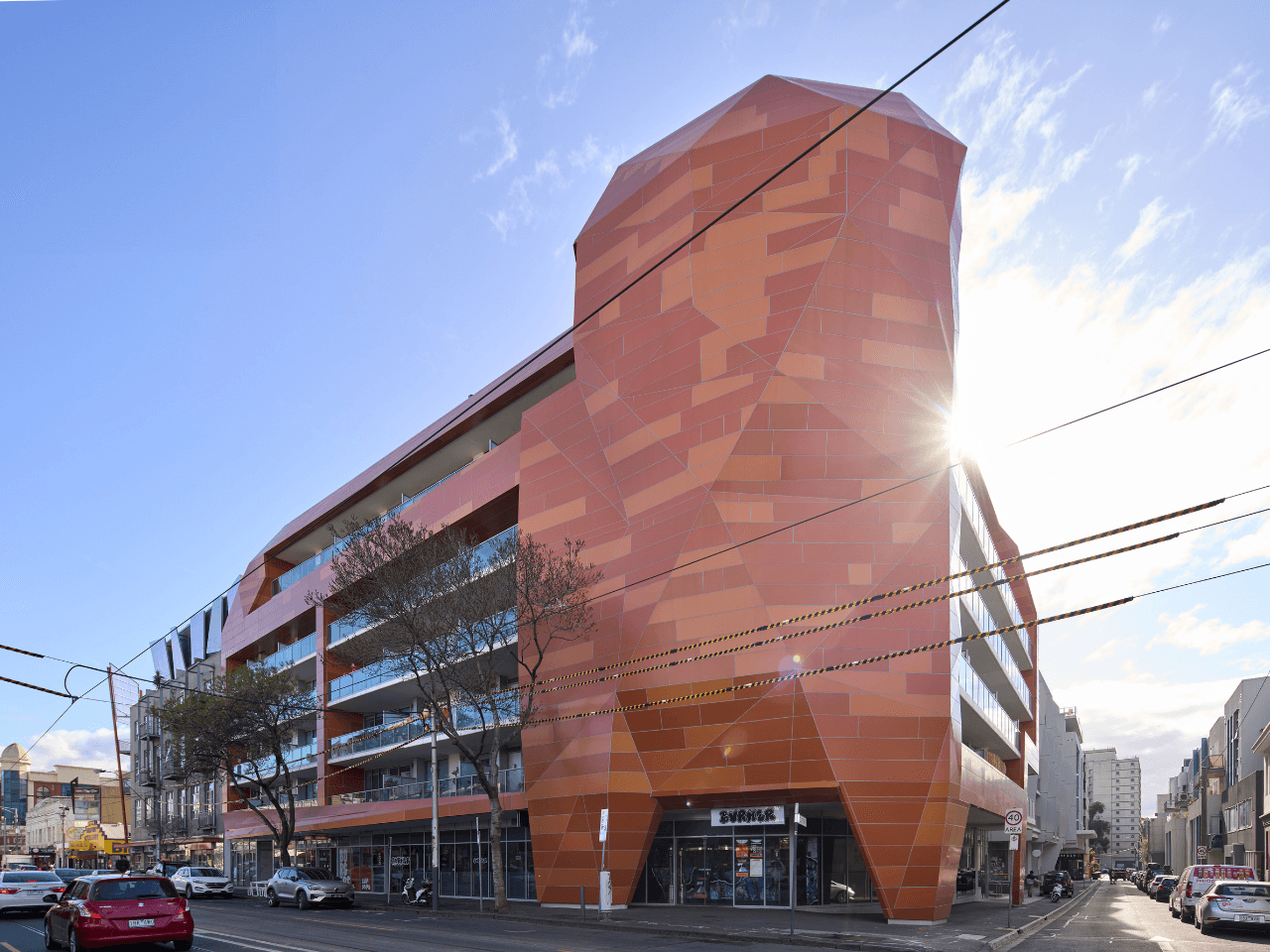
Contemporary façade reclad of Trilogi Apartments in Prahran with DtS non-combustible ALPOLIC™ aluminium cladding.

Trilogi Apartments, Prahran VIC

Crucial trade-offs and hidden implications

In practice, this means that when architects and designers interpret the sole existence of an EPD as a sustainability guarantee and don’t scrutinise its contents, they can inadvertently specify materials that inflate a project’s environmental footprint. A façade product that appears compliant on paper might come with high embodied carbon, or its warranty might be contingent on a demanding and costly maintenance schedule.

“Take cladding, for example,” Llewellyn says. “Some products may require bi-annual cleaning or treatment to maintain warranty and appearance. Over the lifespan of a commercial building, this leads to increased labour, water, energy use and resource consumption – and adds hidden costs that aren’t reflected in the initial product price or even the EPD.”

This is precisely where a holistic evaluation reveals a product’s true value. “In contrast, ALPOLIC™ NC/A1 not only has one of the lowest embodied carbon footprints in its category but also offers a 20-year full-cover warranty with no requirement for ongoing maintenance,” Llewellyn continues. “Its durability exceeds 50 years, helping reduce waste, lower lifecycle emissions and deliver better long-term value. These are the kinds of insights that can help specifiers make decisions that are genuinely sustainable, not just superficially compliant.”

On large commercial projects, these differences scale up dramatically, affecting everything from environmental performance and building management budgets to tenant satisfaction.

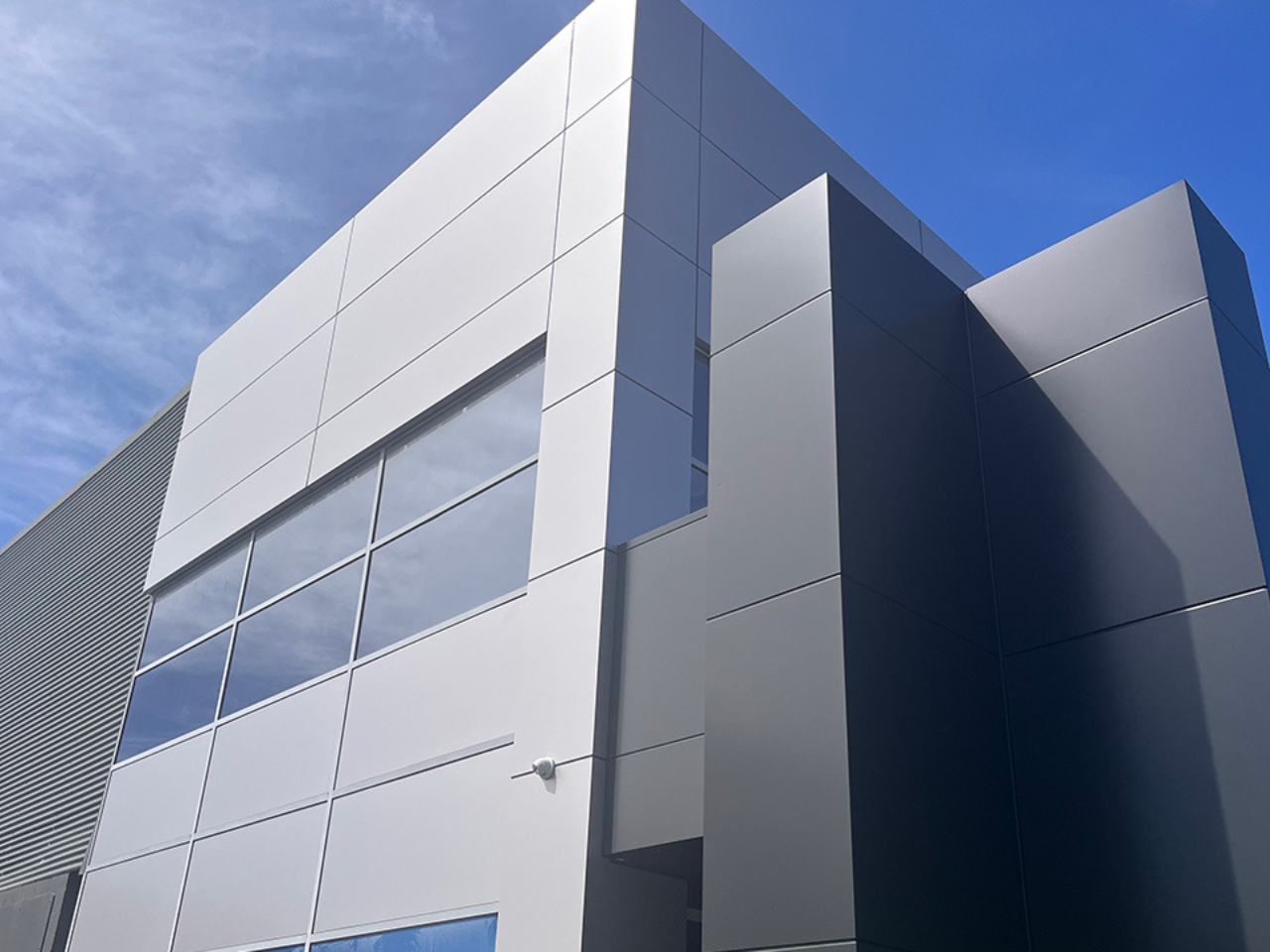
Architectural detail of Charles Perkins Centre, demonstrating low embodied carbon cladding.

Charles Perkins Centre, Sydney NSW

Reading between lines: A robust assessment framework

It’s abundantly clear that a truly sustainable specification process involves more than checking if an EPD is in place – it’s about adopting a broader perspective and considering the comprehensive environmental and operational impact of materials.

So, we ask Llewellyn which metrics specifiers should pay extra attention to when evaluating EPDs as they compare products to make sure they gain a proper understanding of a product’s sustainability performance. Here’s a handy breakdown:

  • GWP: Scrutinise the A1-A3 data to understand the upfront environmental impact.
  • Durability and service life: Assess the expected lifespan of the product before it requires replacement.
  • Maintenance requirements: Check if there are long-term inputs required to maintain the product’s performance and warranty.
  • Warranty conditions: Verify that the warranty is comprehensive and covers materials, labour, and rectification without onerous conditions.
  • Fire compliance and safety: Familiarise yourself with this non-negotiable aspect of risk management and occupant safety, especially for façades.
  • Lifecycle cost: Consider the total, long-term cost of ownership, including maintenance, repairs and eventual replacement.
  • Supply chain and local support: Ensure the product is made responsibly and that local stock, technical support and compliance documentation are readily available.
  • End-of-life: Scrutinise whether the product is genuinely recyclable and if it offers a practical pathway for resource recovery in Australia.

Using ALPOLIC™ NC/A1 as an example, Llewellyn explains how these factors can help create a much more comprehensive environmental picture. “ALPOLIC™ NC/A1 is manufactured in Japan by Mitsubishi Chemical Infratec Co., Ltd, a globally respected company known for its ethical production and strict environmental controls,” he offers. “But what makes it especially practical for Australian projects is its local stockholding and support through Network Architectural, which ensures shorter lead times, reduced local freight emissions and direct access to compliance documentation and warranty support.”

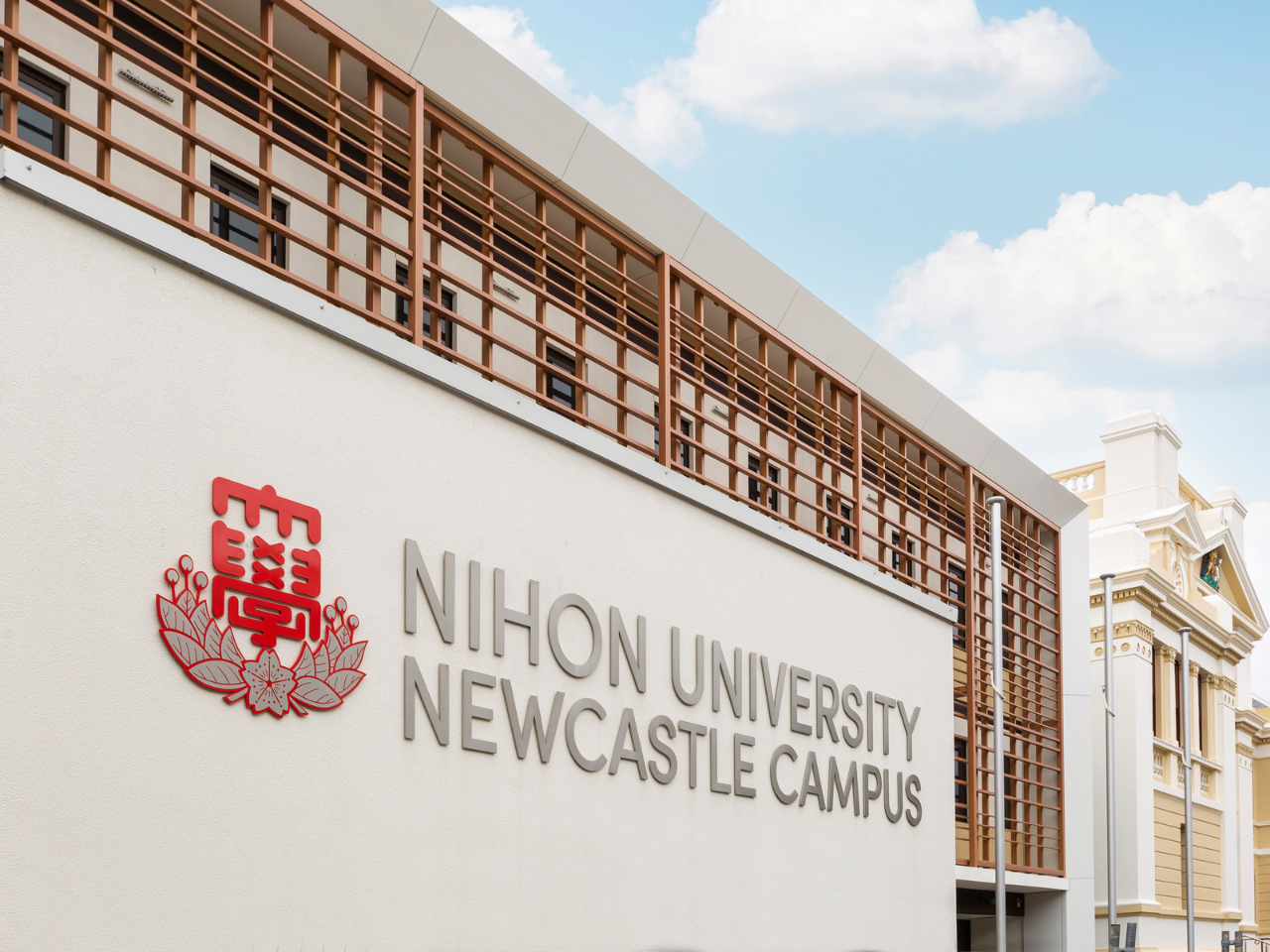
Exterior of Nihon University campus building in Newcastle with distinctive façade design.

Nihon University, Newcastle NSW

Outcomes over checklists: The measured future

Now, Llewellyn is clear that this demand to move beyond a simple EPD box-checking exercise doesn’t just lie with the specifiers. As we continue to shift further away from passive compliance to a more sophisticated whole-of-life approach to sustainability – “a good thing,”he points out – manufacturers and suppliers have a responsibility to provide greater transparency and deeper insights.

“That’s why, at Network Architectural, we take a proactive approach,” Llewellyn explains. “And not only supplying materials that meet stringent compliance and performance standards, but also educating the industry on how to specify better. We offer detailed product guidance, warranty transparency and CPD presentations that unpack lifecycle costs and risks.”

And while EPDs will continue to anchor the sustainable specification process as a vital assessment tool, it’s paramount for industry professionals to integrate this data with critical performance, durability, compliance and ethical sourcing insights.

“Our vision is a construction sector where environmental responsibility is measured not just in checklists but in real-world outcomes – materials that perform for decades, reduce maintenance waste and lower carbon emissions across their full lifecycle,” Llewellyn concludes. “That’s how we can build better buildings – and, ultimately, a better built environment.”

Specifying sustainable aluminium: Understanding the real environmental footprint of façade materials with LCA

Modern façade of Fraternity Club, Wollongong, showcasing sustainable aluminium cladding.

Fraternity Club, Wollongong NSW

The concept of Life Cycle Assessment (LCA) is by no means new. However, while in many instances it remains in the “nice-to-have” category, Llewellyn Regler, Network Architectural’s National Technical Manager, predicts a shift. “In the next 5-10 years, we expect LCA to move to a compliance necessity, especially as embodied carbon caps and government procurement standards tighten,” he explains.

However, despite LCA’s undeniable importance, a substantial gap between principle and practice can significantly hinder the sustainable specification of building materials, such as aluminium cladding.

Same but different: The aluminium assumption

“One of the biggest misunderstandings we encounter is the assumption that all aluminium products have roughly the same environmental profile,” explains Llewellyn, who earlier this year ran an in-depth CPD course on the topic. “In reality, there are vast differences depending on factors like core composition, coating technology and end-of-life recyclability.”

Understanding LCA is essential to deciphering these differences. To help architects distinguish between sustainable products and those that merely claim to be so, we asked Llewellyn to demystify the methodology and outline how to turn complex data into a powerful design tool that satisfies the demands for environmental accountability, including those outlined in the National Standard of Competency for Architects 2021.

Non-combustible mineral core aluminium cladding on the Scarboro Toyota dealership façade in Osborne Park.

Scarboro Toyota, Osbourne Park NSW

What is LCA?

At its core, LCA is a systematic analysis of the environmental impacts of a product across its entire lifecycle. To properly assess a product, an LCA is conducted using specialised software according to standards like ISO 14040 and ISO 14044 to examine everything from raw material extraction to disposal, including manufacturing processes, energy consumption and the material’s recyclability. It also considers factors ranging from long-term life expectancy and maintenance requirements to the depletion of fossil fuels, offering a nuanced and comprehensive view of a product’s lifecycle impacts.

Decoding LCA’s vernacular

To understand this intricate data and avoid the common specification misunderstandings, it’s essential to grasp LCA’s vernacular, starting with cradle-to-gate and cradle-to-cradle.

In simple terms, cradle-to-gate refers to the first part of the lifecycle, encompassing the impacts of raw material extraction, transportation and manufacturing – everything required to prepare a product for shipment from the factory. While it’s a vital metric covering the A1-A3 stage, it’s not the whole picture. Cradle-to-cradle, on the other hand, represents the complete, holistic view that architects should strive for. It assesses the entire lifecycle, including the use phase, end-of-life processing and the potential for the material to be reused or recycled into new products, closing the loop.

Being able to differentiate between the two, Llewellyn stresses, is essential. “A key knowledge gap lies in differentiating between embodied carbon at early stages (A1-A3) versus operational impacts and end-of-life scenarios,” he elaborates.

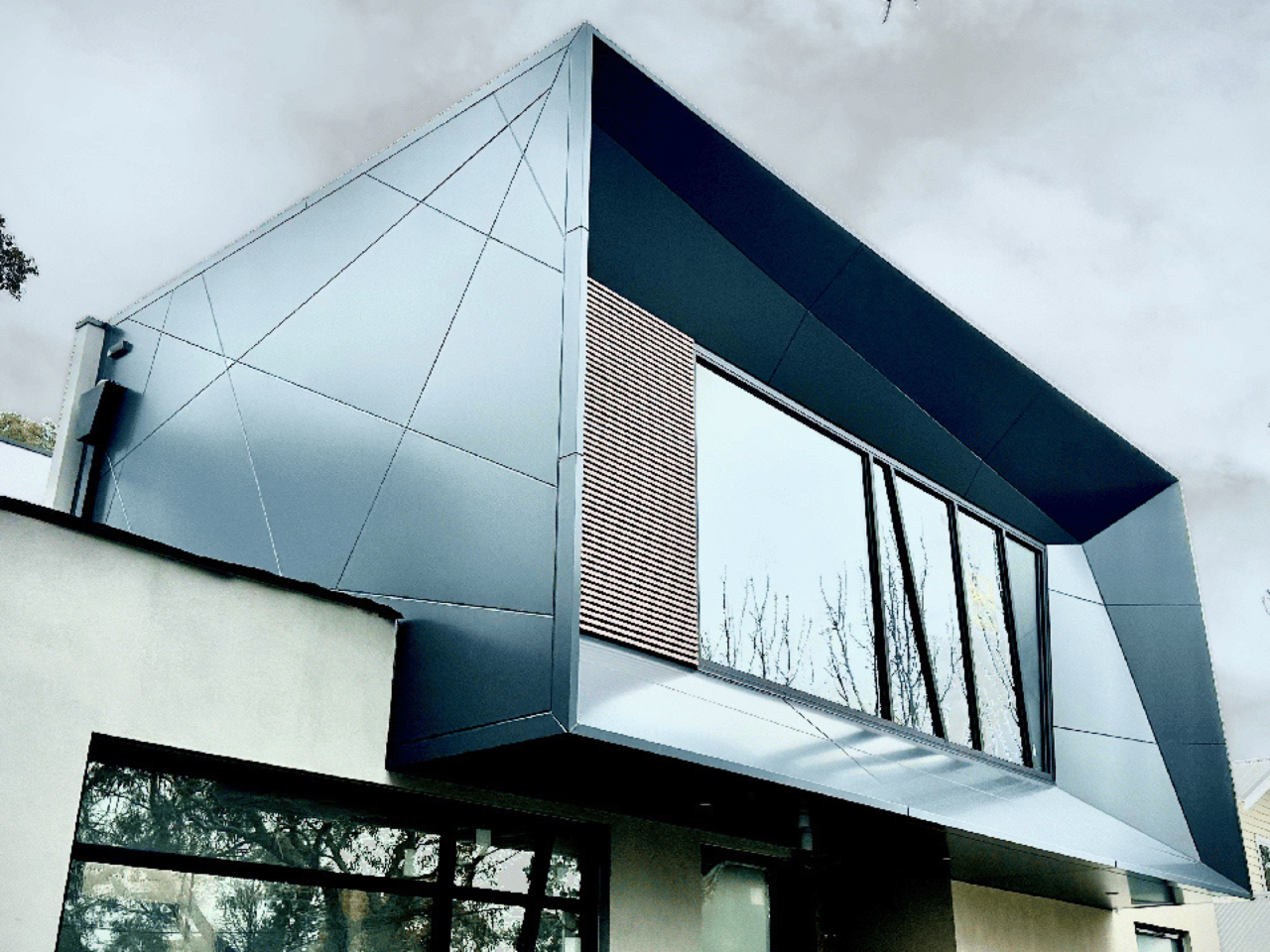
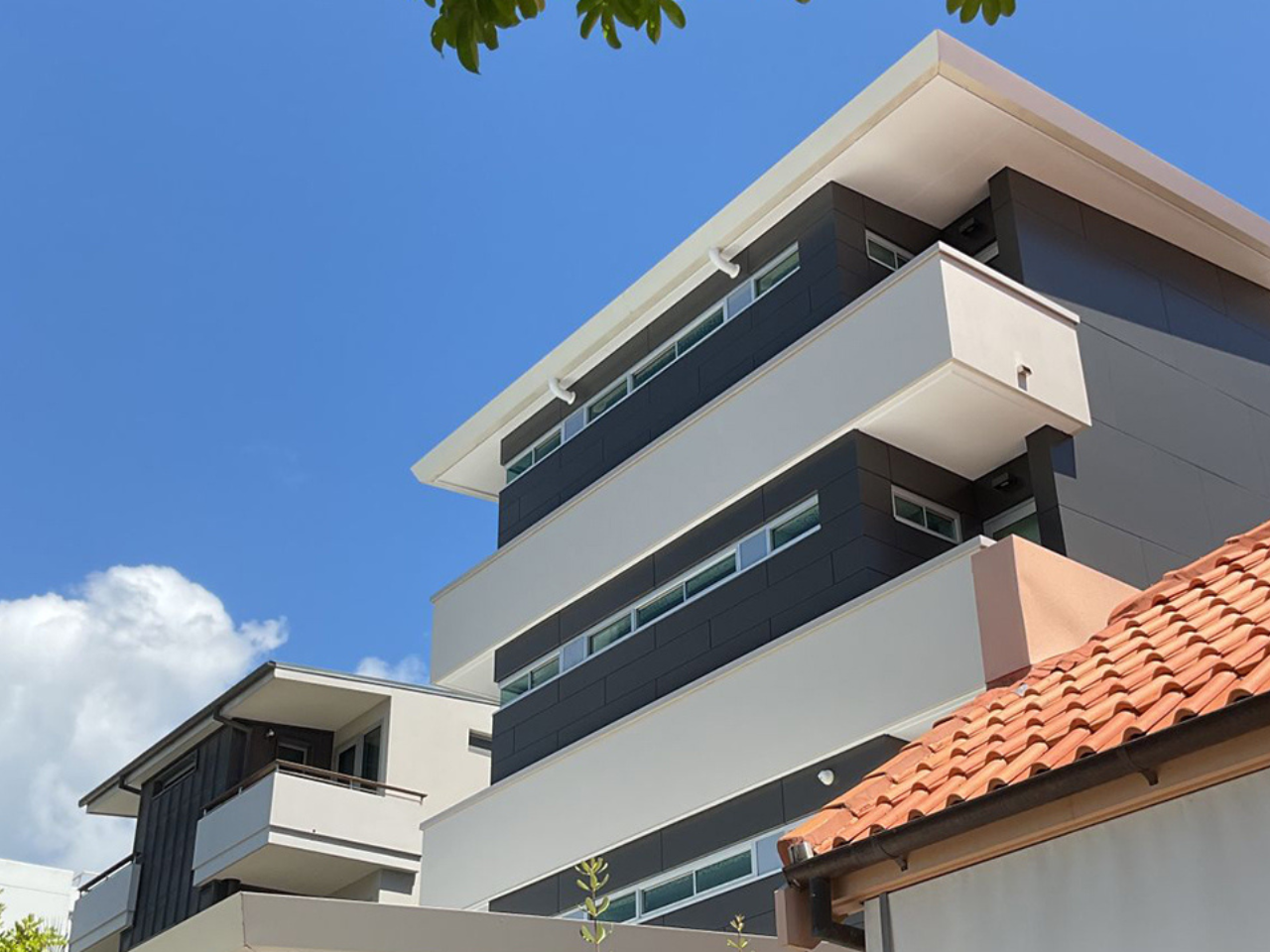
Residential façade detail on Lake Road, Blackburn featuring aluminium cladding.

Lake Road, Blackburn VIC

The stages of LCA

LCA enables industry professionals to bridge that gap, providing essential data about a product’s impact across the critical lifecycle stages that answer fundamental questions about the material or product in question.

Product Stage (A1-A3): Where does it come from and how is it made? Includes raw material supply, transportation, and manufacturing.

Construction Stage (A4-A5): How does it become part of the building? Encompasses the transport of the finished product to the site and the installation process.

Use Stage (B1-B7): How does it live in the building? Covers long-term maintenance, repair, and replacement needs, plus operational energy and water use.

End of Life Stage (C1-C4): Where does it go when it’s done? Includes deconstruction, transport from the site, waste processing, and final disposal.

Benefits Beyond Stage (D): What is its next life? Accounts for the future benefits of reuse, recovery and recycling, linking directly to the circular economy.

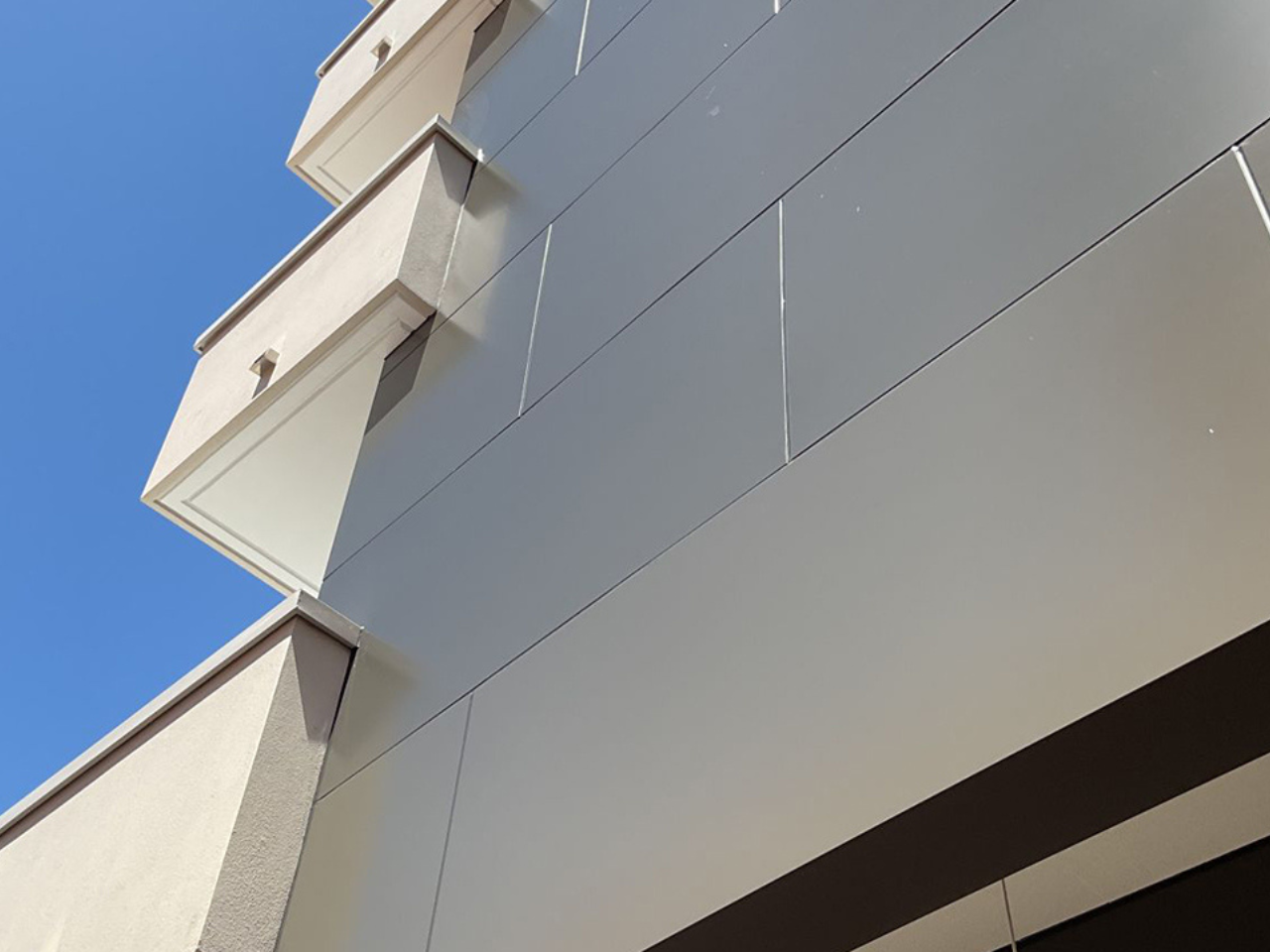
Reclad façade of the Sandpiper Building in Queensland with DtS non-combustible aluminium panels.

Recladding – Sandpiper Building, QLD

From energy-intensive Stage A1…

Understanding the impact of each stage – and giving it appropriate weighting – is paramount. Llewellyn explains that Stage A1 is often the most significant contributor to environmental impact due to energy-intensive mining and refining processes, particularly with virgin aluminium.

Understandably, architects usually focus on this stage the most. However, he notes that it’s the frequently overlooked end-of-life stage that presents significant challenges and opportunities.

… to the underestimated Stage C

“Stage C is often underestimated,” Llewellyn explains. “Many assume materials are recycled or disposed of responsibly without truly understanding the environmental cost or practicality of doing so.”

While aluminium itself is infinitely recyclable, using just 5% of the energy required for primary production, complexity arises with aluminium composite panels (ACPs), where the core materials may not be recyclable.

Network Architectural, an Australian distributor of the advanced ACP ALPOLIC™ panels, for instance, address this consideration head-on. The company’s take-back partnership with PanelCycle creates a verified pathway for recycling the panels, ensuring that the aluminium skins and mineral cores are properly separated and recovered, turning a theoretical recycling claim into a tangible reality that can be verified through the product’s EPD.

And that, Llewellyn adds, is the key. “The actual recyclability depends on product design, which is why we recommend project teams request EPDs that include complete Stage C and interrogate manufacturers’ claims regarding recyclability and landfill,” he explains, stressing the importance of challenging suppliers to translate abstract figures into practical, project-specific terms.

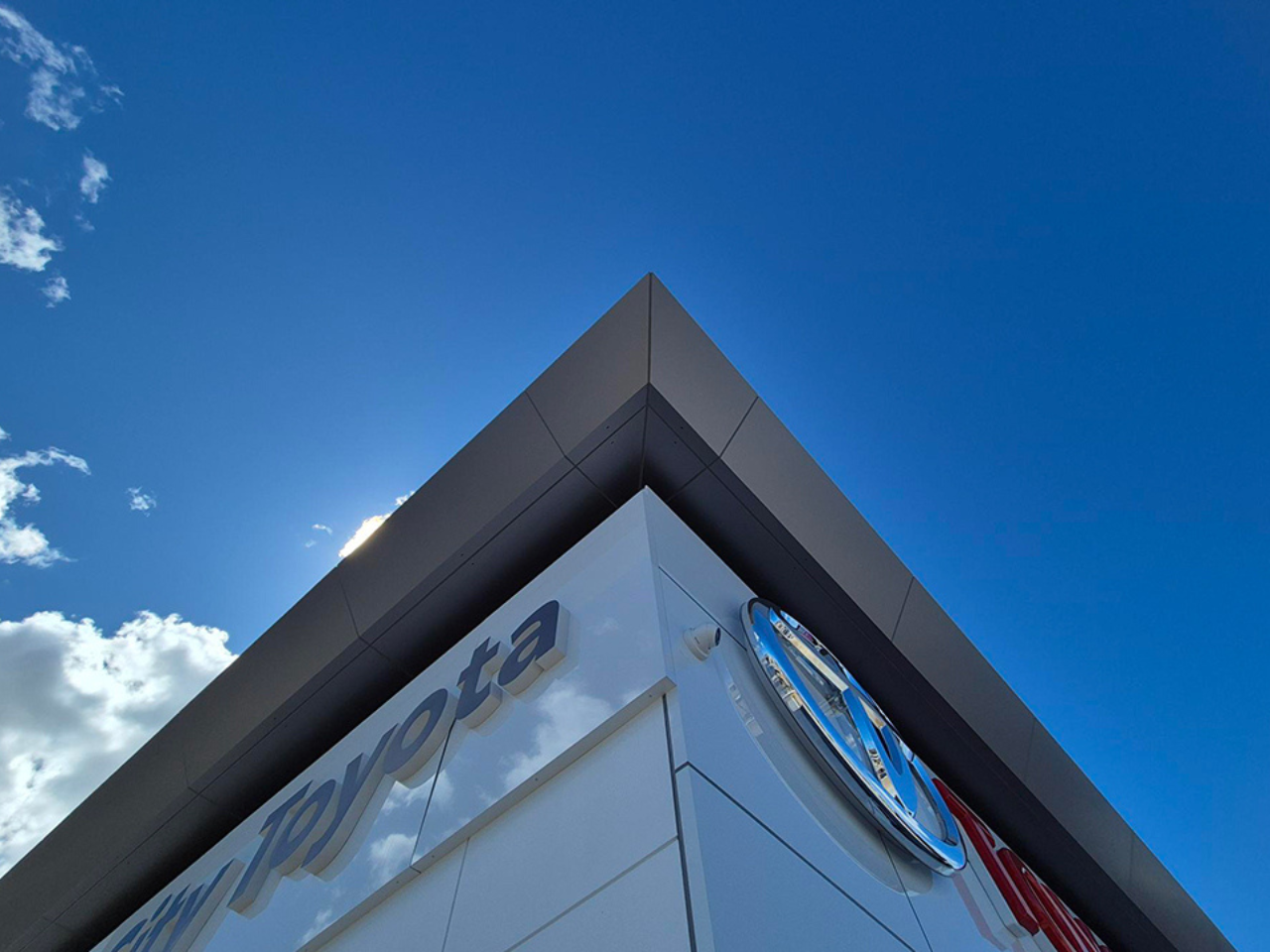
Aluminium façade cladding on City Toyota dealership, Nedlands, Western Australia.

City Toyota, Nedlands WA

Integrating LCA into the design workflow

With that in mind, when is the best time to integrate this holistic methodology into the design process to maximise its potential for a project’s sustainability profile?

“The best time to apply LCA thinking is during schematic design when material decisions are still flexible and cost modelling is underway,” Llewellyn explains, adding that embedding it into early-stage concept presentations and specification checklists can help it become second nature. “It has to become a non-negotiable part of the workflow.”

To start, he suggests that specifiers should shortlist products with third-party verified EPDs – ideally EN 15804-compliant and from trusted program operators, such as Australasia EPD or Global GreenTag. Doing that helps avoid greenwashing, mitigates the risks of internal, unverified LCAs – plus, specifying products with verified EPDs can directly contribute to earning points in rating schemes like the Green Building Council of Australia’s (GBCA) Green Star.

Once shortlisted, Llewellyn recommends comparing each EPD’s most crucial data points. In addition to the Stage C data he’s mentioned, he highlights a few other points architects and designers should pay attention to ensure sustainable aluminium cladding specification:

  • Global Warming Potential (GWP): The primary carbon footprint metric.
  • Recycled vs. Virgin Content: A key indicator of upfront embodied carbon.
  • Durability and Maintenance (Stage B): Indicators of how long the product will last and what the environmental cost of its upkeep is.

Putting theory to the test: An LCA case study of aluminium cladding

Now, the transformative potential of EPD-backed data comes to the fore when specifying aluminium cladding. The material is energy-intensive to produce but can be highly durable and recyclable – and the physical construction of different cladding types directly impacts their environmental footprint.

With various aluminium cladding options available on the market – including older-style solid aluminium, modern ACPs like the non-combustible mineral core ALPOLIC™ NC/A1 and lighter-weight but less durable corrugated and honeycomb panels – LCA becomes essential.

Close-up of non-combustible mineral-core aluminium cladding on the Sandpiper Building façade, Queensland.

Recladding – Sandpiper Building, QLD

Not all aluminium cladding is environmentally equal

An EPD-based comparison for 1m² of different cladding types reveals significant differences. To start with, ALPOLIC™ NC/A1 has a GWP of 48.9 kg CO₂e, which is significantly lower than a typical 3mm solid aluminium cladding at 86.8 kg CO₂e and a generic composite panel with no recycled content at 95.2 kg CO₂e.

“Solid aluminium generally has a higher GWP due to its significantly greater mass per m² and the energy required to produce virgin aluminium,” Llewellyn explains. “And this is especially important in cladding, where the surface area is vast and minor improvements in GWP per m² can scale up quickly.”

This performance gap widens during the use stage. A typical 3mm solid aluminium panel uses a PVDF paint coating and requires periodic cleaning to maintain its 15-year conditional warranty. It is also prone to oil canning – visible distortion from thermal expansion and contraction – and can suffer from inconsistent colour between panels, even those from the same batch. In contrast, ALPOLIC™ NC/A1 features a superior Lumiflon FEVE paint coating, which has a life expectancy of over 50 years and is guaranteed not to fade. “ALPOLIC NC’s 20-year maintenance-free warranty can help reduce impact during Stage B,” Llewellyn says. “Which often gets overlooked in specifications.”

And while both ALPOLIC™ NC/A1 and solid aluminium are recyclable, the solid aluminium panels’ higher mass per m² leads to greater energy use in processing. “As a result, ALPOLIC™ NC/A1 offers a lower overall environmental burden at end-of-life, thanks to its efficient material use and design for recyclability,” Llewellyn explains, highlighting ALPOLIC™ NC/A1’s stronger performance in Stage C.

From theory to reality: A Sydney project transformation

A recent commercial project provides a real-life context for this data-driven comparison – and highlights the importance of employing LCA thinking early in the process.

“The project team initially specified 3mm solid aluminium cladding. However, after reviewing independently verified EPDs and assessing the embodied carbon impact across the façade, the team switched to ALPOLIC™ NC/A1,” Llewellyn describes. “The outcome was significant – a 38% reduction in GWP across the façade.”

He adds that, beyond the environmental gain, the switch also delivered practical benefits. “ALPOLIC NC/A1’s lighter construction and greater dimensional stability meant faster installation and reduced engineering complexity, particularly important given that solid aluminium is more prone to oil canning and often requires additional stiffeners and a heavier gauge frame.”

Plus, the ongoing maintenance and cleaning costs were significantly reduced, positioning this project as a powerful example of how sustainability, performance and cost efficiency can successfully align when decisions are informed by precise, comprehensive and verified data.

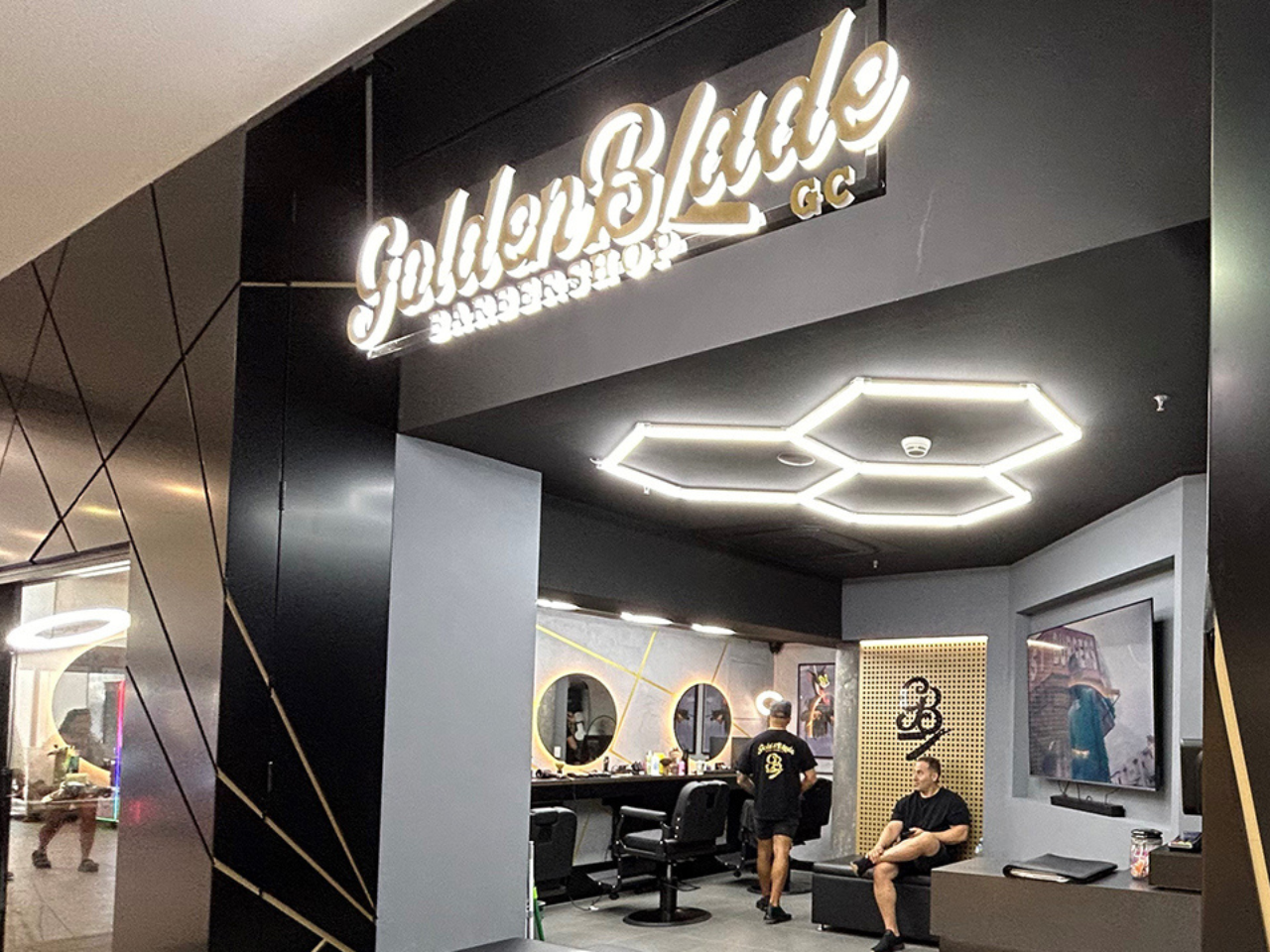
Distinctive Golden Blade Barbershop façade in Queensland clad with DtS non-combustible aluminium panels.

Golden Blade Barbershop, QLD

The future is measured

This holistic, data-driven approach genuinely empowers architects to master the complex balancing act of weighing critical environmental outcomes against functionality, design versatility and lifecycle costs. And, as Llewellyn points to a deeper integration of LCA with BIM, which will enable real-time assessments during the design phase in the next few years, the message is clear – the time to build LCA expertise is now. And Network Architectural is ready to help navigate this transition.

“We’re committed to staying ahead by providing not just compliant products, but education and support that empowers better decision-making,” Llewellyn concludes. “From CPDs to 1:1 spec support and transparent EPDs, we want to make sustainability practical. Our role is to simplify the complexity of LCA so that architects can specify with confidence, knowing the material they choose aligns with both performance and planetary responsibility.”

Zero-carbon aluminium: Distant dream or inevitable reality? Network Architectural weighs in

Gadigal Station interior with curved aluminium ceiling and wall panels

Gadigal Metro Station, Sydney NSW

Aluminium is the quintessential material of modern architecture. Light, strong and endlessly versatile, it’s allowed the industry to push the architectural envelope in ways that were impossible a century ago. It is, by all accounts, a material of the future. However, as one of the building sector’s most significant carbon culprits, aluminium’s undeniable brilliance has also come at a cost which, for decades, has seemed manageable. The industry has focused on incremental gains, celebrating recycled content while framing the immense energy required for primary production as an impenetrable challenge, positioning the concept of zero-carbon aluminium as a distant dream.

But it’s becoming abundantly clear that this environmental price tag is one the industry – and the planet itself – can no longer afford. And according to industry expert Steven Fraser, Ceiling Systems Manager at Network Architectural, that entire perspective is now obsolete.

“The assertion that aluminium’s high energy intensity renders zero-carbon production a distant dream is increasingly outdated,” he says. “While aluminium smelting is indeed energy-intensive – accounting for approximately 3% of global electricity consumption – advancements in technology, renewable energy integration and supportive policies are making zero-carbon recycled aluminium a tangible goal.”

And while Steven admits there isn’t an easy, single solution, the pathway forward is an actionable industry blueprint anchored by the strategic integration of robust, existing and emerging solutions. In fact, he is confident that by combining large-scale recycling with renewable energy and innovative smelting technologies, a transition to zero-carbon recycled aluminium that is not only technically possible but also economically advantageous is at our fingertips.

Nan Tien Institute, NSW – Architectural project featuring aluminium façade

Nan Tien Institute, NSW

Real challenges or dangerous excuses?

Steven is crystal clear: the challenges ahead are not insignificant. The industry rightly points to high capital costs for upgrading smelters, the technological maturity of innovations like inert anodes, and the logistical and infrastructure hurdles of shifting to renewables. Plus, the global supply chains are dominated by coal-powered production.

“China produces about 60% of the world’s aluminium, much of which is powered by coal,” Steven explains. “And efforts to relocate smelters to regions with cleaner energy sources, like Yunnan province, face challenges due to inconsistent hydropower availability.” This is also compounded by the varying environmental regulations and policies across different countries that can either hinder or accelerate decarbonisation initiatives.

These certainly are real and serious considerations, but to dismiss them as permanent roadblocks is not just a failure of imagination but a rejection of responsibility. As we collectively face profound environmental consequences, loyally clinging to the operational status quo is no longer a viable option because, as Steven points out, the stakes are simply too high. “Fundamentally, if we don’t start aiming to decarbonise aluminium production, we’re on track for the planet to lose a food bowl due to climate change,” he warns, emphasising the stark reality that to some seems too abstract to take seriously. “Food bowl regions are critical to global food security and their loss would have profound economic and humanitarian impacts and may lead to higher food prices and potential continental mass migrations.” With the gravity of inaction as a sobering backdrop, Steven points to strategic integration of key areas that can help make the technical and economic feasibility of zero-carbon aluminium possible by transforming the material’s lifecycle from linear and carbon-intensive to circular and clean.

The Bond, NSW – sustainable commercial building featuring aluminium façade

The Bond, NSW

Infinite recycling

He says that the most accessible and impactful tool at industry’s disposal is recycled aluminium and, rather than a niche solution, it’s the primary low-carbon resource stream.

“Recycling aluminium requires significantly less energy – up to 95% less, in fact – than producing primary aluminium, leading to reductions in energy consumption and associated costs,” Steven explains. “Plus, the International Aluminium Institute reports that recycling aluminium can save up to $2 billion annually in energy costs across the global industry.” He adds that because aluminium is infinitely recyclable, it should never end up in landfill, which can help minimise disposal costs too. “It’s one of a handful of building products where business will pay you to remove it from the site as it has an intrinsic value as scrap,” he explains.

Naturally, harnessing this potential involves policy support, enhanced collection systems and – crucially – advanced sorting technologies to ensure high-quality scraps can be reintegrated into a closed-loop system. “These are not simple scrap yards,” Steven clarifies. “Modern facilities now use sophisticated methods like X-ray transmission and near-infrared sorting to accurately separate different aluminium alloys, preserving their quality for high-grade architectural applications.”

Kirribilli, NSW – Aluminium cladding detail on residential building

Kirribili, NSW

From grid burden to green partner

Steven also points out that the decarbonisation of aluminium is intrinsically linked to the decarbonisation of our electricity grids, and the material’s robust energy requirements can be transformed into an asset in a renewables-led system.

“Transitioning to 100% renewable energy is pivotal for achieving zero-carbon aluminium production,” he says. “Given that aluminium smelting is highly energy-intensive, the carbon footprint of aluminium is closely tied to the energy sources used. Shifting to renewable energy sources like hydropower, wind and solar can drastically reduce emissions.”

With smelters like Tomago in NSW consuming up to 10% of the state’s electricity, the scale of the challenge is evident. But it’s also an opportunity – these facilities can act as robust industrial batteries, providing services that stabilise grids with high penetrations of intermittent solar and wind power.

Government support – like Australia’s $2 billion commitment in production credits to assist aluminium smelters in transitioning to renewable energy by 2036 – is already galvanising this transition. And Steven points to Rio Tinto’s Boyne smelter in Queensland, which has signed a 20-year agreement to be powered primarily by solar energy, as an example of this broader industry shift. “This single initiative is expected to meet about 80% of the smelter’s needs, resulting in a substantial reduction in carbon emissions and demonstrating that the large-scale shift to renewables for aluminium production is already underway in Australia.”

Kingswood TAFE, NSW – Modern educational building with aluminium finishes

Kingswood TAFE NSW

Smelting without the smoke

The other piece of this intricate puzzle is eliminating the emissions inherent in the smelting process. Groundbreaking smelting technologies are moving from the lab to commercial-scale reality, fundamentally reimagining the chemical equation of aluminium production. Steven explains that innovations like ELYSIS’s inert anode, Hydro’s HalZero process and Molten Oxide Electrolysis (MOE) share a common, revolutionary outcome.

“This innovation eliminates all direct greenhouse gas emissions, emitting only pure oxygen as a byproduct,” he says, using the joint venture between Alcoa and Rio Tinto, ELYSIS, which replaces traditional carbon anodes with inert materials in the smelting process. “A demonstration plant is underway at Rio Tinto’s Arvida smelter in Quebec, aiming to produce up to 2,500 tonnes of commercial-quality aluminium annually without direct emissions.”

MOE, on the other hand, is an emerging technology that uses electricity to extract aluminium from ore without carbon emissions. “It offers a pathway to fully decarbonised aluminium production,” Steven notes. And, most importantly, when combined with a 100% renewable power source, it encourages a move past just low-carbon and towards zero-carbon aluminium.

Trilogi Apartments, VIC – Multi-residential project with aluminium façade

Trilogi Apartments, VIC

Sustainability: The new profitability

The argument that this transition is too expensive is based on an outdated economic model that fails to factor in carbon risk, market demand or brand value. And Steven stresses that a genuinely sustainable product is no longer just an ethical choice – it’s a significant competitive advantage too.

“As global demand for sustainable materials rises, aluminium produced with low or zero-carbon emissions can command premium prices,” he explains. “Manufacturers and consumers are increasingly open to paying more for sustainably produced materials, recognising the long-term environmental and economic benefits.”

Plus, early adoption of zero-carbon positions companies ahead of inevitable compliance requirements, potentially avoiding future costs associated with regulatory changes, strengthening supply chains against volatile fossil fuel markets – and attracting investment in a world increasingly guided by ESG principles.

The specifier’s power

However, this transition will not be driven by producers alone. Architects, designers and specifiers are the gatekeepers of material selection, and their decisions send powerful signals to the entire supply chain. This influence starts with immediate carbon savings through material specification.

“Before we even get to how the aluminium is produced, we should consider how we can use less of it,” Steven urges. “This is where material efficiency becomes a powerful tool for decarbonisation. Using a product like ALPOLIC™– aluminium cladding with a non-combustible mineral core, which is known for superior flatness and durability – means we can achieve the same architectural results with significantly less material volume than solid sheeting. It’s a simple, immediate choice that can have a direct and positive impact on a project’s embodied carbon.”

The same principle applies to other aluminium-based architectural elements – including high-performance ceiling systems, which often utilise lightweight panelised solutions designed for extended lifespans, easy installation and full recyclability. “Choosing ceiling systems that incorporate recycled aluminium and are designed with disassembly in mind can make a meaningful contribution to a project’s overall sustainability profile,” Steven notes.

This principle of efficiency, combined with a commitment to demanding better products, forms the basis of a powerful specification strategy that can actively drive the market forward. “Prioritise sustainable materials: select aluminium products with verified low-carbon footprints for construction projects,” Steven highlights. “And, crucially, incorporate circular design principles – design structures that facilitate the reuse and recycling of aluminium components at the end of their lifecycle.”

“This push for sustainable specification must be supported by a parallel industry effort to standardise carbon footprinting,” he adds. “This will ensure architects have transparent and reliable data to compare products.” Underpinned by industry-wide commitment to transparent reporting and education about the benefits of low-carbon aluminium in construction, specifiers have genuine power to accelerate this change. “Starting today,” Steven adds.

The Bond, NSW – Commercial development showcasing sustainable aluminium design

The Bond, NSW

The inevitable future

The poignant message emerging from Steven’s robust analysis is an optimistic one: the era of carbon-intensive aluminium is genuinely drawing to a close. The fusion of large-scale recycling, abundant renewable energy and revolutionary smelting technology sets a technically viable path to a decarbonised future for this essential material. And considering the disastrous alternative, the towering challenges on this journey now seem more like fundamental milestones than impenetrable barriers. Especially because industry pioneers like Network Architectural, who keenly promote industry-wide adoption of sustainable building materials and practices, are here to help overcome the hurdles.

“As a leader in commercial architectural products, we can significantly influence the adoption of low-carbon aluminium,” Steven sums up. Network Architectural offers aluminium building products that utilise low-carbon or recycled aluminium, collaborates with suppliers committed to sustainable aluminium manufacturing practices and – crucially, bringing both sustainability and profitability back into one conversation – advises clients on the environmental and economic benefits of choosing low-carbon aluminium for their projects.

A Station Like No Other: Gadigal’s Bespoke Metal Ceilings Brought to Life

Entrance of Gadigal Metro Station

In the heart of Sydney, beneath one of the busiest intersections in the CBD, lies a new icon of modern transport infrastructure — Gadigal Station. As part of the Sydney Metro City & Southwest project, this underground marvel is not only a feat of engineering and urban design but also a cultural and architectural landmark. Formerly known as Pitt Street Station, it has been renamed to honour the Gadigal people of the Eora Nation, reflecting a powerful commitment to truth-telling and Indigenous recognition.

But beyond its cultural importance and transport function, Gadigal Station is also a design masterpiece — particularly in the stunning, bespoke metal ceilings that grace its interiors. Developed through an extraordinary collaboration between durlum, Foxville Projects, and Network Architectural, the ceiling system is one of the most complex and ambitious durlum has ever undertaken. It’s a testament to design innovation, flexibility, and the tireless service behind the scenes.

Delivered by CPB Contractors, Gadigal Station is part of an Integrated Station Development (ISD) running between Park and Bathurst Streets. The platforms sit approximately 17 to 20 metres below ground, making it the shallowest station on the City & Southwest line. With over 10,000 workers contributing to its construction, and 9,000 commuters expected to pass through each morning peak, the scale and impact of Gadigal Station are immense.

The project was led by Foster + Partners as the design lead in collaboration with Cox Architecture, with significant contributions from Sydney Metro’s internal teams and design consultants. Their shared vision focused on creating an experience that was as inspiring as it was functional, incorporating Indigenous heritage, world-class infrastructure, and modern aesthetics.

Gadigal Metro Railway Station with Durlum Metal Ceilings

A Metal Ceiling Design Without Limits

Within this extraordinary build, the bespoke ceiling system stands out as both a structural and artistic achievement. Developed and delivered by Network Architectural using durlum metal ceilings, the solution spanned more than 5,000 square metres — covering the platform tunnels and pedestrian adits with intricate architectural detail.

“This was one of the most complex projects we’ve ever worked on,” said Paul Sheehan, Ceilings Division Manager at Network Architectural. “It wasn’t just about supplying a ceiling — it was about co-creating a solution in real-time with the installer and design team, piece by piece, to ensure every millimetre delivered on the vision.”

Foxville Projects, one of Australia’s premier ceiling installers, led the installation. Their collaboration with Network Architectural began after successful work on Victoria Cross Station. In early 2021, Foxville invited Network Architectural to “take a look” at the Pitt Street build. What followed was nearly three years of design refinement, prototyping, and hands-on support — a level of service Network Architectural is known for. 

Gadigal Metro Railway Station Train Entrace with Durlum Metal Ceilings

Bringing Gadigal Metro Station Bespoke Ceiling to Life

At the heart of the ceiling design was a commitment to customisation and precision. The project was divided into three major design elements:

  1. The PSD Elements: These included the walls, custom louvre, bulkheads and bullnoses, and integrated lighting panels — with every fourth panel designed as an access point for maintenance. Above the platform screen doors, curved bronze bulkheads raked down to the floor, providing both visual continuity and functional form.
  2. The Signature durlum Tubes: Running the full length of the interior space, these 63mm metal tubes were meticulously aligned with the GRC wall panels, both vertically and horizontally. The backing panels featured perforation for acoustic ceiling performance, while also maintaining accessibility. “We ensured every join in the tubes aligned precisely with the joins in the GRC panels — the attention to detail was second to none,” Paul explained.
  3. The Boom Panels: These ceiling panels in the adits (walkways) concealed essential services such as lighting, ventilation, and fire systems. Featuring three-dimensional curves — not only upwards but also outwards — these panels required advanced manufacturing to meet the design complexity. Their seamless finish masked the underlying infrastructure while contributing to the station’s unique visual rhythm.

Design flexibility was key throughout the project. Network Architectural’s in-house design team worked in lockstep with Foxville’s Design team, iterating via 3D drawings and physical prototypes. “This project was being designed on the go. Some areas took weeks to finalise due to the complexity of the radius curves and the integration with concrete walls. But the end result speaks for itself,” Paul noted.

Close-up of durlum metal ceilings in Gadigal Metro Station
Close up of durlum metal ceiligns in Gadigal Metro Railway StationClose up of durlum metal ceiligns in Gadigal Metro Railway Station

The station is also a canvas for Indigenous storytelling. The name “Gadigal” is not just symbolic; it signifies a powerful truth-telling initiative. Councillor Yvonne Weldon of the City of Sydney described it best: “The first step of that truth telling is making sure that we are heard, we are seen, and we are recognised — and that’s what we have in Gadigal station.”

Art installations, including massive 12.5-metre murals titled The Underneath by Callum Morton, enhance the immersive design. Inspired by historic tunnels and local waterways, they echo both the natural and industrial history of the site. More than 10,000 handmade porcelain enamel tiles were used in the entrance areas, reinforcing the tactile, human scale of the design.

World-Class Design, World-Class Collaboration

For Network Architectural and durlum, delivering this project wasn’t just about fulfilling a brief — it was about enabling vision at scale. By embedding their team into the design and installation process, they ensured that the ceilings not only matched the architectural intent but elevated the entire experience.

“This was a massive undertaking, and the project would not have succeeded without true collaboration between the installer, the design team, and our internal design manager,” said Paul. “We were constantly adjusting, solving challenges, and ensuring every detail came together.”

With over 5000 sqm of bespoke metal ceilings, countless design hours, and dozens of prototypes, the finished ceiling is a testament of what’s possible when flexibility, craftsmanship, and service come together.

As commuters descend into Gadigal Station, they are met not just with a world-class transport hub, but with an architectural experience that tells stories — of the city, of culture, of design excellence. The bespoke metal ceiling plays a central role in creating this identity.

From sweeping bulkheads to three-dimensional curves, every element was purpose-built to contribute to the beauty, functionality, and durability of this space. It is a station built for generations — a landmark not only of infrastructure but of what thoughtful design and expert execution can achieve.

durlum metal ceilings in Gadigal Metro Railway Station

Network Architectural & Bespoke Metal Ceilings

Whether the project is large-scale and complex or smaller in scope, bespoke metal ceiling solutions demand collaboration and precision. Network Architectural’s in-house architectural team partners with designers, builders, and installers from concept through to completion — ensuring every metal ceiling system is expertly tailored and flawlessly executed. To see how our team has brought other standout projects to life, explore our projects — and if you’re planning a project of your own, get in touch with us today to start the conversation.